
Yes, service your Saab’s Haldex/XWD system on a schedule, and no, “lifetime fill” is not a reason to skip it. Fit a genuine filter and oil kit at the intervals below, using a Saab-specific kit rather than generic hardware. If “Service XWD” is already showing or a DTC is logged, check the fluid level and look for leaks immediately. Book a workshop visit if pump current reads outside 2.5 to 3.5A.
TL;DR:
- Regularly servicing the Haldex system is essential to prevent fluid degradation, filter clogging, and pump failure, with recommended intervals ranging from 10,000 to 35,000 miles depending on the generation.
- Using the correct OEM parts, such as the BorgWarner 20986573 kit, and following the vent fill procedure with a scan tool is crucial for proper service and system health verification.
- Signs of system stress include the “Service XWD” message, stored codes like C0407 or C0403, and visible metal debris in the old filter or delayed rear engagement.
- Ignoring accurate fluid levels and pump current readings risks ongoing system issues, which can escalate to costly repairs or component replacements.
- DIYers equipped with a scan tool, appropriate kits, and basic tools can complete the service in under two hours, but professional help is recommended for seal, piston, or pump repairs.
Table of Contents
- What is a Saab Haldex service, exactly?
- Which parts fit a Saab 9-3 or 9-5 XWD system?
- How often should you service the Saab Haldex system?
- How do you service a Saab Haldex/XWD system step by step?
- What do “Service XWD” and codes C0407/C0403 actually mean?
- What tools and fluid specs do you actually need?
- Who backs this procedure, and where do the part numbers come from?
- Should you do this yourself or book a specialist?
- Get the exact Saab Haldex kit before you start
- Where to check the procedure yourself
- Sources
What is a Saab Haldex service, exactly?
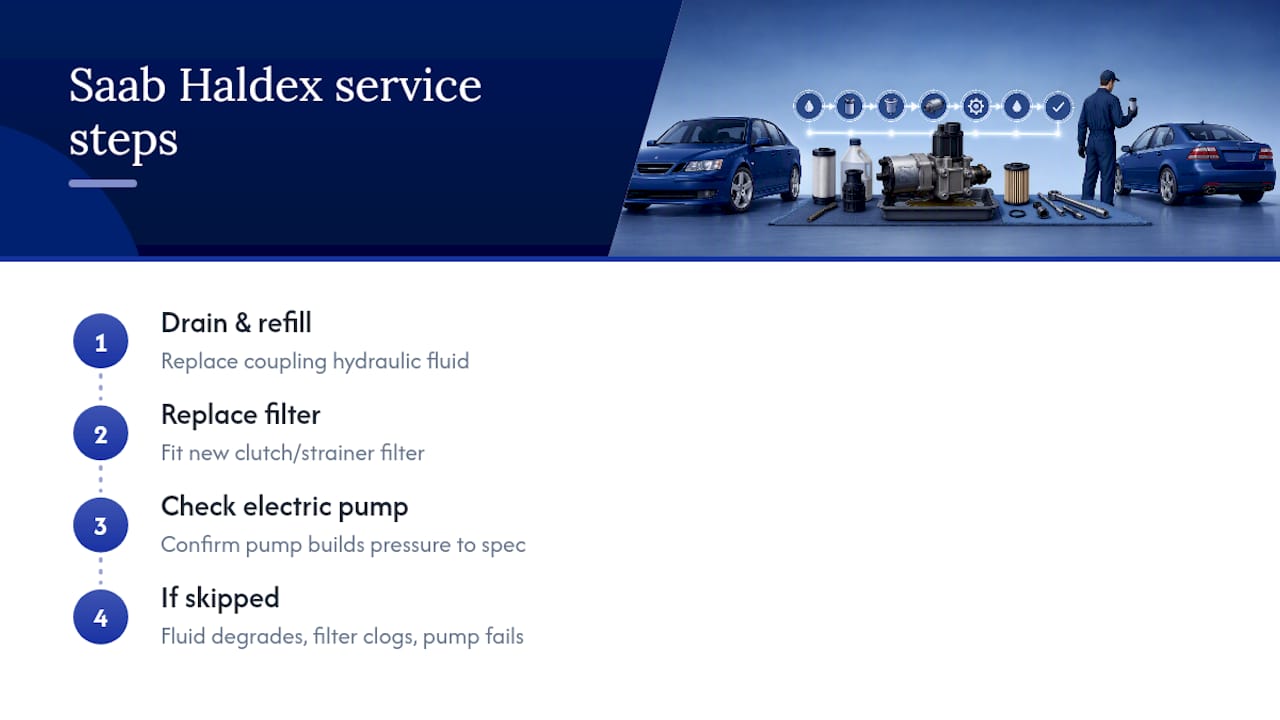
“Haldex” and “XWD” get used almost interchangeably on Saab forums, and that causes confusion. XWD (Cross Wheel Drive) is Saab’s branding for its all-wheel-drive system, introduced on the 9-3 and 9-5 from around 2008 onwards. The Haldex coupling sits inside that system: a hydraulically actuated clutch pack that shifts drive torque to the rear axle when the front wheels lose grip. A “Haldex service” and a “Saab XWD service” refer to the same job. You’re draining and refilling the coupling’s hydraulic fluid, replacing its filter, and confirming the electric pump that pressurises the clutch is working within spec.
Skip this and the eLSD clutch fluid degrades, the filter clogs with clutch material, and the pump struggles to build pressure. That’s exactly the failure pattern behind the dashboard warning covered further down.
Which parts fit a Saab 9-3 or 9-5 XWD system?
Getting the right kit matters more here than on most maintenance jobs, because Saab, Opel, and Vauxhall all shared the same BorgWarner-built Haldex units, and mixing up part numbers is a common DIY mistake.
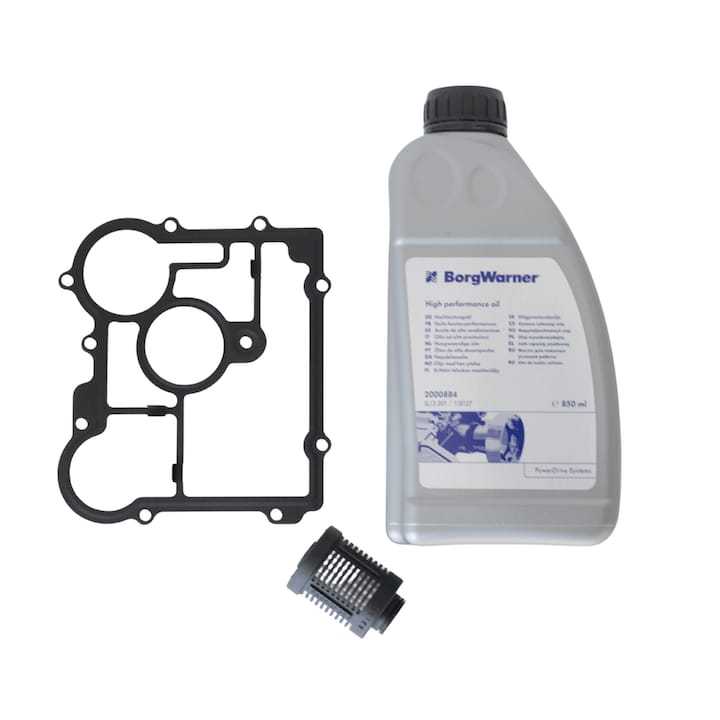
- BorgWarner 20986573 Coupling Oil & Filter Kit (850ml) is the genuine OEM filter and oil kit for routine service. It includes the filter element, a new gasket, and 850ml of the correct coupling oil, which covers a standard fluid-and-filter refresh on 9-3 and 9-5 XWD models fitted with the BorgWarner-generation coupling.
- BorgWarner Coupling Filter Kit 20986573 is the same OEM part listed under an alternate catalogue entry. Buy whichever listing is in stock; the SKU and contents are identical.
- SAAB Opel Vauxhall 22765779 Rear Differential-Oil Pump, Oil & Filter Kit 20986573 goes further. It bundles the rear differential oil pump alongside the same filter and oil kit, which is what you need if you’re also replacing the pump rather than just servicing the coupling.
Cross-reference your fitment against the OEM part numbers documented in Saab service notes: 20986573 for the filter kit and 22956728 for the eLSD clutch piston kit, which is a separate purchase if you’re dealing with a seal or piston fault rather than routine service. A few extras are worth having on the bench regardless of kit: a spare crush washer for the fill plug, a length of clean hose for vent filling, and a shop rag supply, because Haldex oil stains everything it touches. Check the fitment notes on each service kit listing against your exact model year before ordering, since Saab’s XWD hardware changed more than once across the 9-3 and 9-5 production run.
How often should you service the Saab Haldex system?
Interval guidance varies more than owners expect, largely because Saab’s own documentation is inconsistent and some dealers have told customers no service is needed at all.
- Gen1/Gen2/Gen4 couplings: roughly 20,000 to 30,000 miles.
- Gen5 couplings: closer to 10,000 miles, reflecting a tighter tolerance design.
- Community practice on 9-3 and 9-5 forums: many owners settle on servicing around every 35,000 miles regardless of official wording, treating it as cheap insurance against a much costlier repair.
Owners often hear “lifetime fill” from dealers, but that phrase tends to precede a rebuild bill, not follow one. Scheduled service is what keeps the pump from working overtime against degraded fluid.
Don’t wait for the mileage marker if any of these show up sooner: the “Service XWD” message on the dash, a stored DTC, visible metal particles in the old filter when you finally check it, or a noticeable delay or slip in rear-wheel engagement on loose surfaces. Those are signs the system is already stressed, not just due.
How do you service a Saab Haldex/XWD system step by step?
This is a job for a DIYer comfortable working under a lifted car with basic hand tools, plus one piece of kit that isn’t optional: a scan tool capable of reading live pump motor current. Without it, you’re guessing whether the fill actually worked.
What you’ll need: a lift or axle stands rated for the job, a torque wrench, a fill hose or syringe for vent filling, PPE (gloves and eye protection; Haldex oil is unpleasant on skin), and your chosen kit from above.
- Support the vehicle securely on axle stands or a lift, with the rear end level so fluid readings are accurate.
- Locate the vent and fill ports on the Haldex coupling, at the rear differential housing. Clean around both before opening anything, since dirt ingress is a common cause of premature filter clogging.
- Remove the old filter and gasket. Expect the filter to show some clutch material wear; heavy metal contamination is a red flag worth photographing before you continue.
- Drain the old fluid where the service calls for it, catching it in a suitable container for disposal.
- Fit the new filter and gasket from your kit, torqued to spec, no more.
- Refill through the vent fitting, not the drain plug. This is the step Saab’s own technical bulletin is explicit about: the eLSD clutch fills via the vent, and fill volumes vary by procedure, so follow your kit’s supplied quantity rather than guessing.
- Run the pump and monitor current on your scan tool. The target is 2.5 to 3.5A. Readings outside that band mean the pump cavity isn’t fully filled, or there’s a mechanical problem worth investigating before you close everything up.
- Top up and purge air by cycling the system, some DIYers use a few full-throttle acceleration runs in a safe, private area to force the clutch through its range and push trapped air out.
- Re-check the fill level and torque the plug to spec once the purge is complete.
- Clear any stored codes, take a short test drive on varied surfaces, and re-scan to confirm no codes return and pump current holds steady.
Pro Tip: If “Service XWD” reappears within a day or two of a fresh fill, don’t just top it up again. That pattern points to trapped air or a seal leak, and repeating the fill without diagnosing the cause just wastes a second kit.
A prepared DIYer with the tools already on hand can usually complete steps 1 through 9 in under two hours. The most common trip-ups are filling through the wrong port (always the vent, never the drain), underestimating how much fluid the purge routine consumes, and skipping the pump-current check entirely because a scan tool wasn’t on hand. Skip that check and you won’t know the job actually worked until the warning light tells you otherwise.
What do “Service XWD” and codes C0407/C0403 actually mean?
DTC C0407 flags low hydraulic pressure in the Haldex clutch circuit. DTC C0403 relates to filter or pump-side symptoms feeding into the same low-pressure condition. Both point back to one root cause more often than any other: insufficient eLSD clutch fluid, which the Saab bulletin identifies as the leading cause of both codes.
Work through the diagnosis in this order:
- Visual leak inspection around the coupling housing, fill and vent fittings, and differential seals.
- Fluid level check at the rear axle or differential, since a low reading here often explains the fault on its own.
- Pump motor current test via scan tool, comparing against the 2.5 to 3.5A target.
- Filter and gasket inspection, checking for clogging, metal debris, or a failed seal.
One forum rebuild thread illustrates the escalation clearly: a straightforward fluid and filter change resolved the fault initially, but the code returned, and the eventual fix required gasket and seal replacement rather than another top-up.
Repairs fall into three tiers. A fluid and filter service costs the least and fixes most cases caught early. A gasket, seal, or piston kit replacement sits in the middle, warranted when fluid alone doesn’t hold. A pump or differential repair, sometimes paired with reprogramming the RDCCM (Rear Drive Control Module), is the most involved tier and the one where community-reported bills climb toward $1,000 or more once labour is included. Parts-only DIY at the first tier can cost a fraction of that.
What tools and fluid specs do you actually need?
The parts kit gets the fluid right; the tools are what let you confirm the job worked. A scan tool capable of reading live pump current isn’t a luxury here, it’s the only objective way to know the coupling is actually filled rather than just topped up and hoping.
- Scan tool with live pump current data to hit the 2.5 to 3.5A target and confirm the fill actually took.
- Fill hose or syringe sized for the vent fitting, since gravity-filling the wrong way round is a common source of trapped air.
- Torque wrench for the cover bolts and fill plug, tightened to spec rather than “snug”.
- Genuine BorgWarner coupling oil, supplied in the correct volume by the 20986573 kit rather than a generic substitute.
- Piston kit (22956728) kept in reserve if inspection during the service reveals seal wear, so you’re not waiting on a second parts order mid-job.
If you’re already pulling the differential for pump work, buy the combined pump, oil, and filter kit rather than sourcing the pump separately. It’s the difference between one parts order and three separate trips to different suppliers.
Who backs this procedure, and where do the part numbers come from?
This guide draws on Saab’s own technical bulletin for the vent-fill procedure and pump-current target, cross-checked against years of forum-documented DIY repairs from 9-3 and 9-5 owners who’ve done the job repeatedly, some more than once on the same car. Editorial oversight comes from Mindaugas, whose background covers AWD system parts sourcing and fitment across Haldex-equipped platforms.
The part numbers that recur through Saab’s diagnostics, 20986573 for the filter kit and 22956728 for the piston kit, map directly onto Haldexparts’ Saab-fit catalogue, so the numbers you see referenced in bulletins and forum threads are the same ones you’ll find on the product pages when you’re ready to order.
Should you do this yourself or book a specialist?
DIY makes sense when the job is routine fluid and filter service, you’ve got a scan tool that reads pump current, and you’re not already seeing repeat fault codes. Hand it to a specialist once you’re into seal, piston, or pump territory, or if the RDCCM needs reprogramming, since that’s diagnostic equipment most home garages don’t carry. Before you start, confirm you’ve got the lift or stands, the correct kit on the bench, scan tool access, and a couple of hours uninterrupted. Missing any one of those turns a two-hour job into a stalled one.
— Mindaugas
Get the exact Saab Haldex kit before you start
Ordering the wrong filter kit twice costs more time than the service itself, so match the part number to your model year before you check out. Kits referenced throughout this guide are available for selection by model and Haldex generation, helping avoid uncertainty about compatibility with your 9-3 or 9-5.
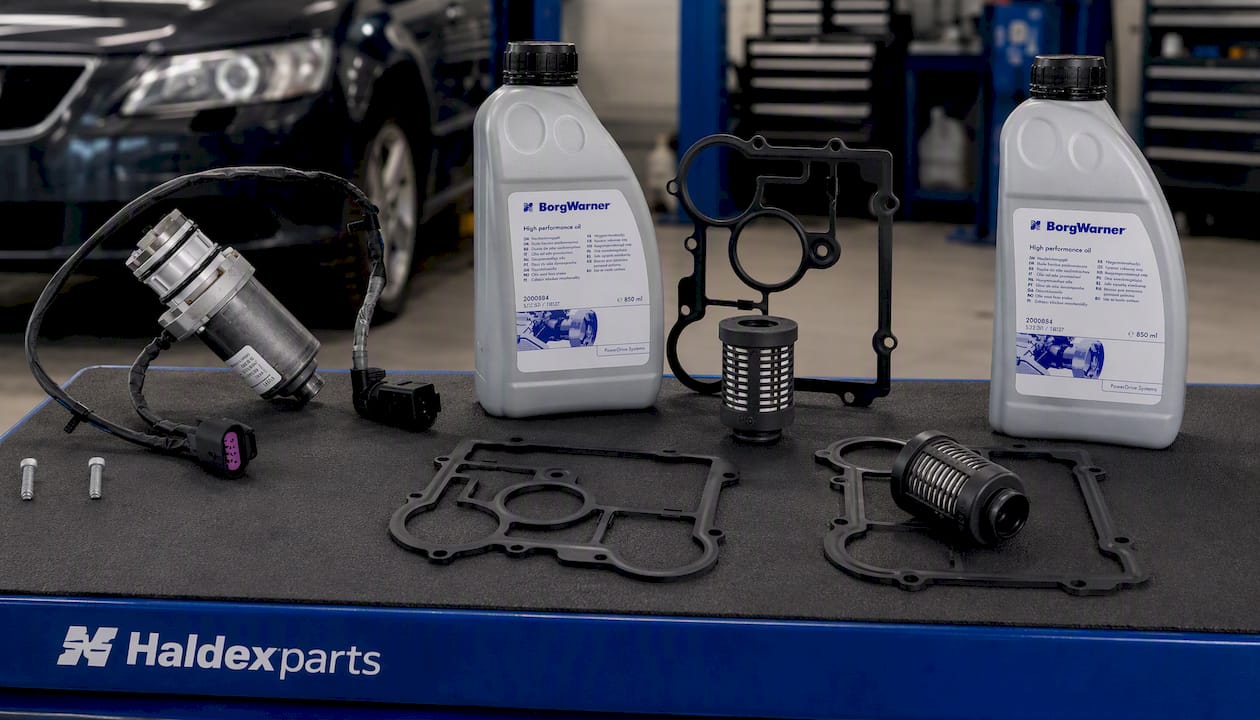
For a routine fluid and filter change, the BorgWarner 20986573 Coupling Oil & Filter Kit covers the job with genuine OEM oil in the correct volume. If your inspection turns up pump wear or you’re planning ahead for a fuller service, the rear differential pump, oil & filter kit bundles everything in one order. If your first-choice filter kit is out of stock, the alternate BorgWarner listing carries the identical part. Use the model and year selector on each listing to confirm fitment, check the supplied oil volume against what your procedure calls for, and order the piston kit alongside if your inspection suggests you’ll need it. Check the website for current shipping offers and consider ordering additional parts if planning ahead rather than reacting to a warning light.
Where to check the procedure yourself
- Saab bulletin on Service Rear Axle message with DTC C0407/C0403
- SaabCentral: XWD service every 35k miles
- SaabCentral: C0407 Service XWD rebuild thread
- Haldexparts AWD service best practices guide
Sources
- Service Rear Axle Message Displayed With DTC C0407 OR C0403 2010-11 9-5 or 9-4X
- XWD service every 35k miles (SaabCentral forum)