
Choose the kit built for your car’s specific Haldex generation, not just its badge or year. That means confirming whether you have a Gen1, 2, 4 or 5 unit before you buy anything. If a pump rebuild is needed, Haldexparts’ BorgWarner 4th Gen Haldex Pump 0AY598549A & Filter 111358 Kit and the AWD Pump Nose Replacement Tips for 1st and 2nd generation pumps cover the two most common DIY jobs. Always check the part number stamped on your unit before ordering.
TL;DR:
- Using the correct Haldex generation identification method, primarily the stamped part number, is essential to avoid ordering incompatible kits.
- Gen1, 2, and 4 units typically use a replaceable filter and require routine fluid changes every 20,000 to 30,000 miles, while Gen5 uses a screen and needs more frequent checks at around 10,000 miles.
- Never mix Haldex coupling fluid with GL5 gear oil, as they are chemically different and can cause clutch slip or system failure.
- Confirm all parts, including crush washers, drain and fill bolts, and the specific fluid specification number, before purchase to prevent costly mistakes.
- OEM-spec fluid and generation-matched components are recommended for reliability and warranty purposes, especially on high-mileage or track-used vehicles.
Table of Contents
- What’s inside a Haldex service kit and why it matters
- How do I know what Haldex generation I have?
- Choosing the right kit for your generation and vehicle fitment
- How often should Haldex fluid be changed, and what does it cost?
- Tools and steps for a DIY Haldex service
- Which Haldexparts kit matches your job?
- Verifying compatibility beyond the generation number
- Branded versus aftermarket kits: what the warranty actually covers
- Questions worth asking before you buy
- Why matching generation is the whole ballgame
- Buy the right Haldex kit for your generation
- Sources
- FAQ
What’s inside a Haldex service kit and why it matters
A proper Haldex service kit is not just a bottle of fluid. Miss one component and you either can’t finish the job or you finish it wrong.
- Haldex coupling fluid — a specific hydraulic fluid, not a generic gear oil, that keeps the clutch pack engaging smoothly.
- Filter or screen — traps metal debris from the clutch pack; Gen1, 2 and 4 units typically use a replaceable filter, while Gen5 relies on a screen.
- Pump seal kit — stops fluid leaking from the pump housing after disassembly.
- Drain and fill bolts with crush washers — reused washers rarely seal properly and cause slow leaks within weeks.
The single most damaging mistake DIYers make is mixing Haldex coupling fluid with GL5 gear oil meant for the rear differential. They look similar, sit next to each other on a parts shelf, and behave completely differently inside the clutch pack. Get this wrong and you can glaze the clutch plates, leaving the system slipping under load. Vendor-assembled kits, such as those from LIQUI MOLY, typically bundle 1 litre of the correct fluid with the filter or screen and seals matched to that generation, precisely to stop this kind of mix-up.
How do I know what Haldex generation I have?
Guessing your generation from the car’s badge alone is how the wrong kit ends up on your driveway. Run through these checks in order.
- Start with your VIN and model year. Most Gen1 units appeared on early-2000s Audi and VW platforms, Gen2 followed through the mid-2000s, Gen4 became common from around 2010 onwards across Audi, VW, Seat and Škoda, and Gen5 arrived with newer direct-injection platforms.
- Find the stamped part number on the unit itself. This is the only truly reliable identifier. A number matching patterns such as 0AY598549A points to a Gen4 pump, for example.
- Look at the filter arrangement. A removable, screw-on filter housing points to Gen1, 2 or 4. A sealed screen with no separate filter cartridge is a Gen5 signature.
- Check pump shape and nose design. Early pumps use a different nose profile to later units, which is why replacement nose tips are sold separately for 1st and 2nd generation pumps.
- When still unsure, cross-reference the part number against a generation identification guide or contact a fitment specialist before ordering.
Skipping the part number check is the step most owners regret. Model year alone gets you close, but running changes within a single model year have caught out plenty of confident DIYers.
Choosing the right kit for your generation and vehicle fitment
Once you know your generation, the kit choice narrows fast. Gen1 and Gen2 units use a replaceable filter and generally need only fluid, filter and crush washers for routine servicing, though pump nose wear is common enough on higher-mileage examples to warrant the separate nose tip. Gen4 units also use a replaceable filter but see more pump failures, which is why a combined pump, filter and oil kit makes sense rather than buying parts separately. Gen5 units skip the filter entirely in favour of a screen, so ordering a filter for a Gen5 car is a wasted purchase.
On fluid choice, OEM-spec fluid matches the factory clutch pack tolerances and is the safer default for daily-driven cars. Performance or aftermarket fluids can offer better thermal stability for track use, but check they meet the same specification the manufacturer calls for, not just a “compatible” label.
Before you check out, confirm four things against your unit:
- Exact vehicle model and model year
- Driveline or gearbox code from your logbook or door sticker
- Engine variant, since some platforms shared a chassis across petrol and diesel Haldex applications
- The stamped part number on the unit
Pro Tip: Photograph the stamped part number on your phone before you order anything. Sellers can confirm fitment in seconds from that number, saving you a return shipment if the listing description is ambiguous.
Haldexparts lists exact SKUs against each generation on its service kit collection rather than generic “fits most models” language, which is where a lot of the fitment confusion in this category actually starts.
How often should Haldex fluid be changed, and what does it cost?
Interval guidance varies meaningfully by generation, and treating every Haldex system the same is how owners end up servicing too rarely or too often.
- Gen1, Gen2 and Gen4: roughly every 20,000 to 30,000 miles, or every two years for low-mileage cars.
- Gen5: shorter screen-service intervals, often closer to 10,000 miles given the smaller screen’s tendency to clog faster than a full filter.
- Fluid-and-filter service labour: roughly 45 to 90 minutes for a competent DIYer, matching the documented Gen5 screen service time.
- Pump service or rebuild: several hours, since it usually means dropping the pump, replacing seals, and sometimes the nose assembly.
Tools and steps for a DIY Haldex service
Most fluid-and-filter services need nothing exotic, but a pump service demands more care.
Tools: fluid syringe or hand pump, socket set matching your drain/fill bolts, a torque wrench, axle stands, a drain tray, spare crush washers, and your vehicle’s workshop manual for torque figures.
- Raise the car safely on axle stands and locate the Haldex unit’s drain and fill bolts.
- Drain the old fluid into your tray, noting its colour and any metal particles.
- Remove and replace the filter cartridge, or clean/replace the screen on Gen5 units.
- Replace pump seals if you’re doing a pump service, using new crush washers throughout.
- Refill with the specified fluid volume, torque bolts to the manual’s figure, and check for leaks after a short drive.
Never top up with GL5 rear differential gear oil. It is not interchangeable with Haldex coupling fluid, and overfilling the unit is just as damaging as underfilling it. Both cause pressure and engagement problems that mimic a failing pump.
Pro Tip: After refilling, drive in a tight, low-speed circle on a loose surface (a gravel car park works well). You should feel the rear end briefly resist the turn as the Haldex system engages. No resistance at all usually means air is trapped in the system or the fluid level is short.
Which Haldexparts kit matches your job?
Matching the job to the right SKU avoids the single most common return reason sellers report: buyers ordering the wrong generation’s kit.
- If your pump has failed or is due a rebuild on a Gen4 platform, the BorgWarner 4th Gen Haldex Pump 0AY598549A + Filter 111358 + high-performance BorgWarner oil Kit covers pump, filter and fluid in one order.
- For the same Gen4 job without the upgraded oil, the BorgWarner 4th Gen Haldex Pump 0AY598549A & Filter 111358 Kit is the leaner option.
- For Gen1 and Gen2 pumps showing wear at the nose, the AWD Pump Nose Replacement Tips let you fix that specific failure point without replacing the whole pump.
Every product page carries the exact part number it replaces, along with fitment notes and current shipping and returns terms, so you can check compatibility against your own stamped unit number before paying rather than after.
Verifying compatibility beyond the generation number
Knowing your Haldex generation gets you most of the way there, but generation alone doesn’t guarantee fitment. Manufacturers shared Haldex platforms across multiple badges: the same Gen4 pump architecture, for instance, turns up across Audi, VW, Seat and Škoda models built in the same period, but not every variant within that window used identical mounting brackets or electrical connectors.
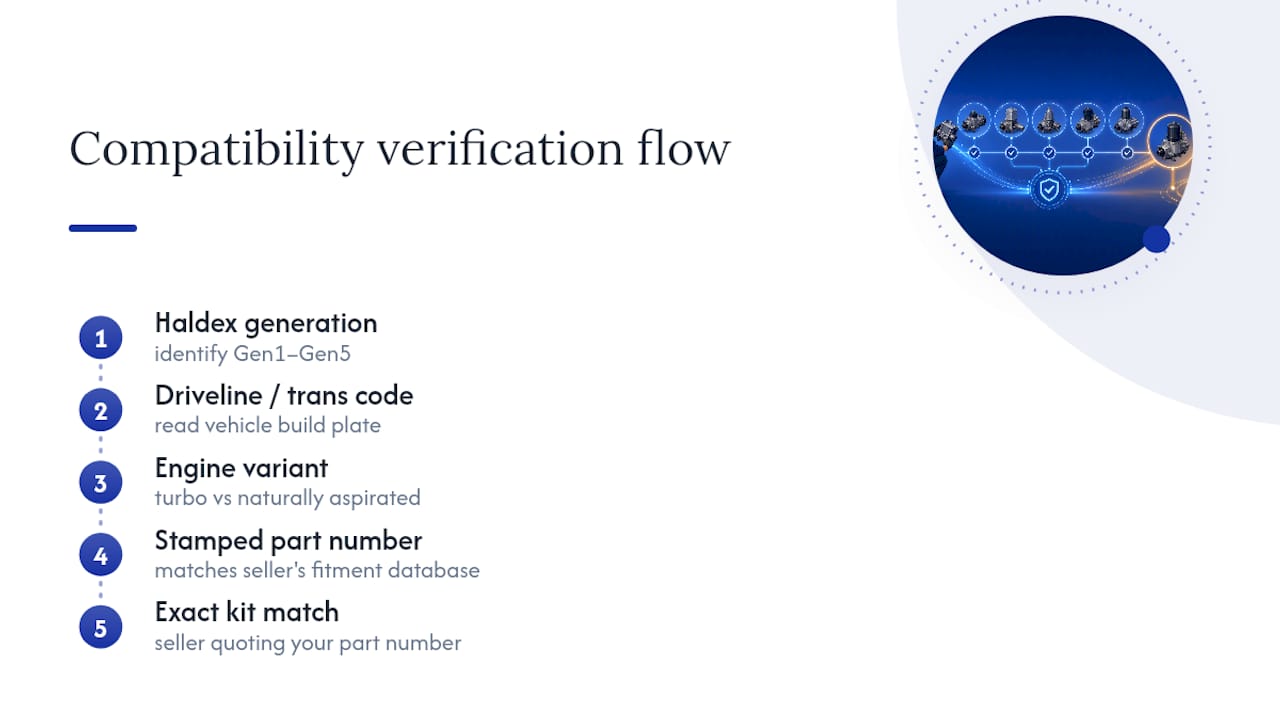
Cross-check three things beyond generation. First, the driveline or transmission code on your vehicle’s build plate, since some models offered both Haldex-equipped and conventional variants within the same generation of chassis. Second, the engine variant, because turbocharged and naturally aspirated versions of the same platform occasionally used different pump housings even within one Haldex generation. Third, and most reliably, the stamped part number on your existing unit, since that number is what any seller’s fitment database actually matches against, not your car’s trim level.
If a listing gives you a fitment table by model and year rather than a bare “universal fit” claim, that is a reasonable sign the seller understands the category. Vendors selling generation-specific kits, as seen across product ranges like LIQUI MOLY’s Haldex kits, publish fitment by both model and generation for exactly this reason. When a listing gives you nothing to cross-check against, ask before you buy. A five-minute exchange with a seller who can quote your part number back to you is worth more than any star rating on the page.
Branded versus aftermarket kits: what the warranty actually covers
The gap between an OEM-spec kit and a budget aftermarket equivalent usually shows up in two places: fluid specification and warranty backing, not in the box’s appearance.
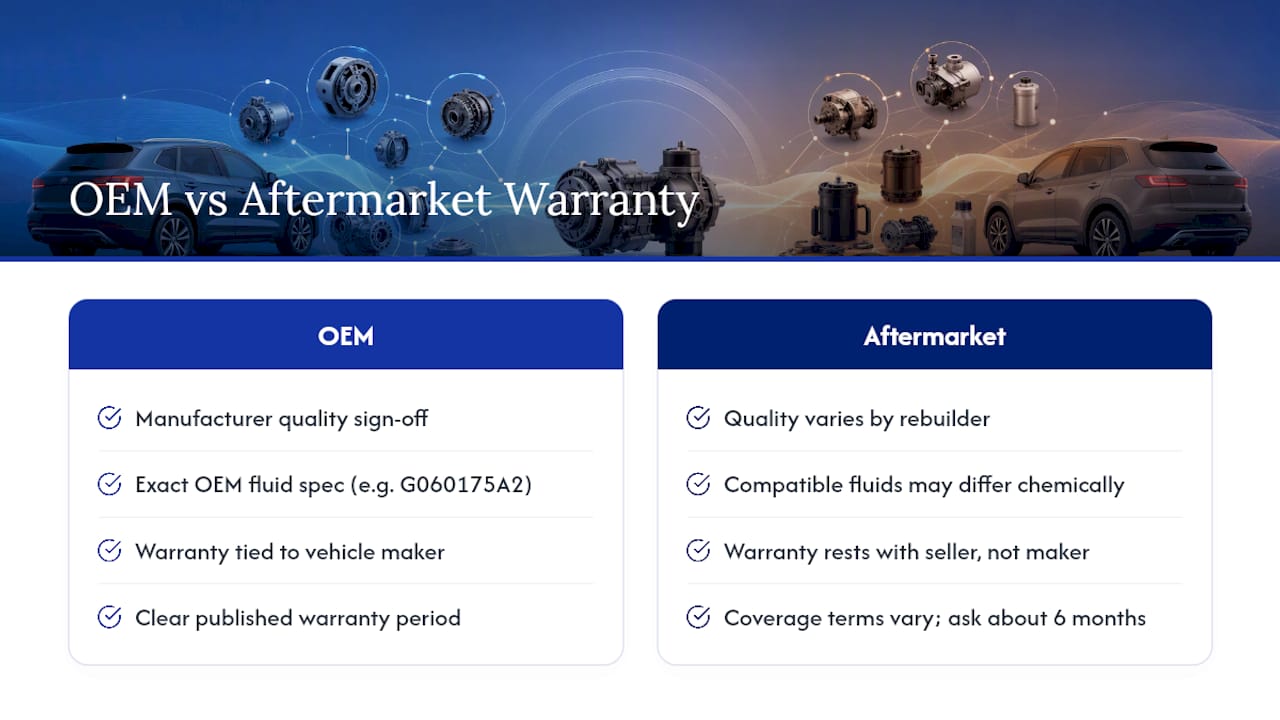
Genuine OEM kits, such as those referencing part numbers like G060175A2 for fluid and 0CQ598305 for the seal kit on Gen5 Volkswagen units, carry the manufacturer’s own quality sign-off. That matters because the fluid’s exact chemical specification affects clutch pack friction behaviour in a way a “compatible” generic fluid may not replicate precisely. A warranty claim on a failed pump is also far more straightforward when you can show OEM-spec parts were used throughout the service history.
Aftermarket and performance kits are not automatically inferior. Reputable rebuilders offering clutch pack upgrade kits for Gen4 and Gen5 units often outperform tired original components, particularly on cars used for track days or towing. The trade-off is that any warranty sits with the aftermarket manufacturer rather than the vehicle maker, and coverage terms vary far more between sellers than they do between dealerships.
Before choosing between the two, ask what happens if the part fails within six months. A branded OEM part usually has a clear, published warranty period tied to the manufacturer. An aftermarket seller should be able to state theirs just as clearly. If they can’t give you a straight answer on warranty length or what voids it, treat that as a warning sign regardless of price.
Questions worth asking before you buy
A quick set of questions to any seller, whether that’s a dealership parts counter or an online listing, separates a complete kit from a costly gap you’ll discover halfway through the job.
Ask whether the kit includes the crush washers and drain/fill bolts, not just fluid and a filter. Plenty of listings show a filter and a bottle of oil in the photo but ship without the small hardware that actually seals the job. Ask for the exact fluid specification number printed on the bottle, not just a brand name, since that’s what confirms it matches your generation’s requirements. Ask whether the filter or screen included matches your specific generation, given how easily a Gen4 filter gets listed against a Gen5 vehicle by mistake.
On authenticity, ask where the parts are sourced from and whether the seller can quote the OEM part number each component replaces. A seller who can’t tell you the fluid’s specification number or the filter’s cross-reference number is often reselling a repackaged generic kit, whatever the branding on the box suggests. Ask about the returns policy specifically for fitment mismatches, since a seller confident in their fitment data will usually offer a straightforward return path if the part turns up wrong.
Finally, ask if rear differential gear fluid is included or needs ordering separately. Some assembled kits bundle it as an add-on, and it’s easy to assume it’s covered when it isn’t, leaving you short on the day you planned to finish the job.
Why matching generation is the whole ballgame
The costliest mistakes in this category aren’t parts failures. They’re ordering errors: the wrong filter, the wrong fluid, a pump kit for a generation the car never had. Every one of those is avoidable with a five-minute check of the stamped part number before you click buy.
Owners who get burned once tend to overcorrect and buy premium everything afterwards, which isn’t necessary either. OEM-spec fluid and the correct generation-matched filter or screen solve most problems. Save the performance upgrades for cars that actually see track days. If you’re unsure at any point, checking with a fitment specialist costs nothing and saves a return shipment.
— Mindaugas
Buy the right Haldex kit for your generation
Haldexparts sells the exact parts this guide points to, matched to generation and part number rather than sold as vague “universal fit” bundles. For a Gen4 pump rebuild, the BorgWarner 4th Gen Haldex Pump 0AY598549A + Filter 111358 + high-performance BorgWarner oil Kit covers the whole job in one order, while the leaner BorgWarner 4th Gen Haldex Pump 0AY598549A & Filter 111358 Kit suits those who don’t need the upgraded oil.
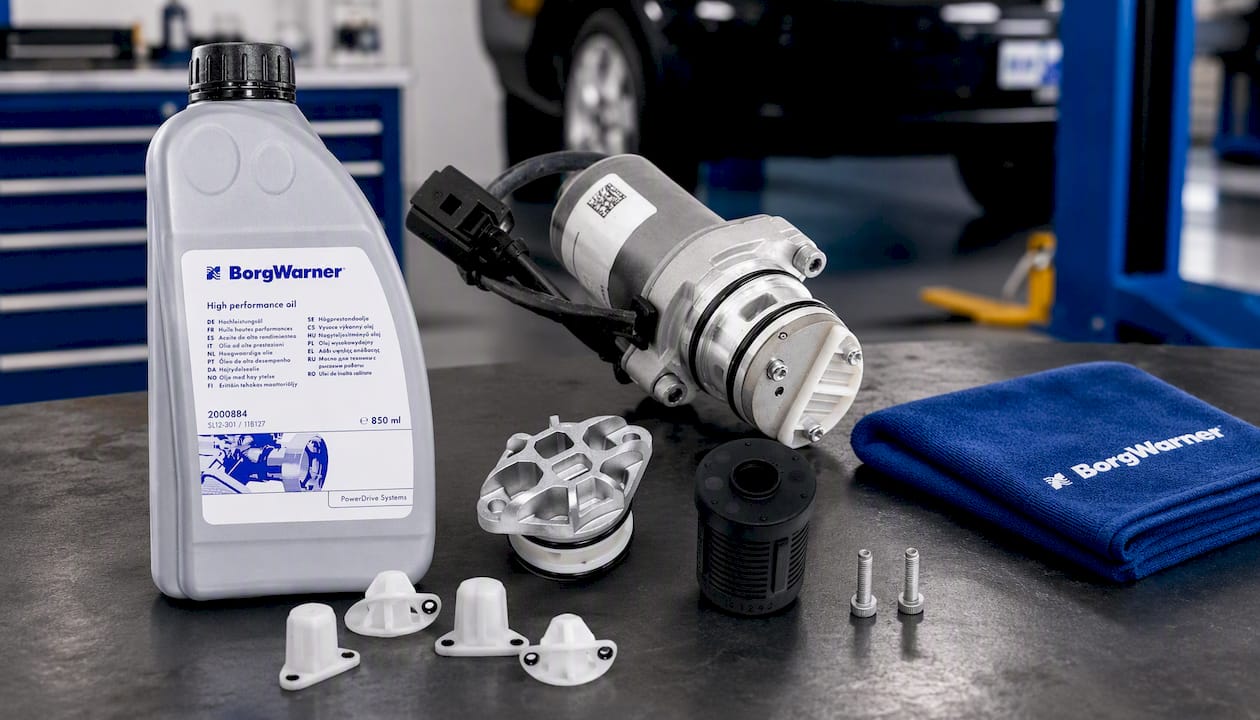
Servicing an early pump instead? The AWD Pump Nose Replacement Tips for 1st and 2nd generation pumps fix wear at exactly the point most Gen1/2 pumps fail, without the cost of a full pump swap. Before you check out, confirm your unit’s stamped part number against the listing and review the shipping and returns terms, especially useful if you’re ordering close to the £150 free shipping threshold. Browse the full service kit range to find the exact match for your car, or head to the Haldexparts catalogue to compare options by generation before you order.
FAQ
How do I know what generation Haldex I have?
Check the part number stamped on the unit itself, since it’s the only fully reliable identifier; model year and whether the unit uses a replaceable filter or a screen give useful supporting clues.
How much does a Haldex service cost?
A fluid-and-filter service costs far less than a pump rebuild kit, and exact pricing varies by seller and whether you choose OEM-spec or performance parts; labour runs roughly 45 to 90 minutes for a fluid service versus several hours for a pump job.
Is Haldex real AWD?
Haldex is an on-demand all-wheel-drive system that engages the rear axle when it detects front-wheel slip, rather than driving all four wheels permanently like a mechanical AWD system.
How often should Haldex fluid be changed?
Gen1, Gen2 and Gen4 systems typically need servicing every 20,000 to 30,000 miles, while Gen5 units need more frequent screen checks, often closer to every 10,000 miles.
What’s the difference between Haldex fluid and rear differential oil?
Haldex coupling fluid and GL5 rear differential gear oil are formulated differently and are not interchangeable; mixing them can damage the clutch pack inside the Haldex unit.