

No, Haldex fluid and ATF are not the same thing, and swapping one for the other is one of the most common causes of AWD failure on Audi, VW, Ford, Land Rover, and Volvo Haldex systems. Haldex fluid is a low-viscosity, friction-modified hydraulic fluid built for a wet multi-plate clutch; ATF is formulated for gearbox lubrication and torque converter hydraulics. If you suspect the wrong fluid has gone into your Haldex unit, stop driving on it, check the OE part number on the bottle against your vehicle’s generation, and don’t top up further until you know exactly what’s in there.
TL;DR:
- Using ATF or differential oil instead of Haldex fluid can cause immediate clutch slip, judder, and potential pump or seal damage.
- Proper Haldex fluid must be low viscosity, flow well at low temperatures, and maintain consistent friction during temperature and wear cycles.
- Identifying the vehicle’s Haldex generation and matching the correct OE part number is essential before buying or refilling to prevent failures.
- Flushing rather than just draining is recommended if contaminated fluid is suspected, followed by a proper refill and filter replacement.
- Relying on generic “any AWD fluid” is risky because Haldex systems depend on specific controlled friction, not just lubrication.
Table of Contents
- Haldex oil vs ATF: what each fluid is actually built to do
- Why ATF or diff oil in a Haldex unit causes real damage
- How to find the correct Haldex fluid for your vehicle
- What to do if the wrong fluid has already gone in
- Getting the right Haldex fluid stocked and specified
- Why the “any AWD fluid will do” advice keeps causing repairs
- Buying the correct Haldex oil and service kit
- Sources
Haldex oil vs ATF: what each fluid is actually built to do
A Haldex unit works nothing like a conventional gearbox, which is the root of the confusion. It’s a wet multi-plate clutch pack that engages progressively to send torque to the rear axle, and the fluid inside has to do two jobs at once: flow fast enough to build hydraulic pressure in milliseconds, and grip consistently enough that the plates don’t slip, judder, or glaze.
ATF is designed for a completely different job. It lubricates gears, cools a torque converter, and carries detergents and anti-wear additives suited to a sealed, low-friction environment. Those same additives work against a wet clutch, softening the controlled friction the Haldex pack depends on.
Independent product data on dedicated Haldex fluids, such as Ravenol’s AWD-H fluid, highlights three properties that separate it from generic ATF or gear oil:
- Low dynamic viscosity, so the pump can build clutch pressure almost instantly on demand.
- Strong low-temperature flow, critical for cold starts when the Haldex system engages hardest.
- Friction constancy across temperature and wear cycles, which is what actually stops shudder.
Pro Tip: If a bottle doesn’t specify friction modifier content or mention wet-clutch compatibility, treat it as unsuitable for a Haldex unit, regardless of what the label calls it.
Why ATF or diff oil in a Haldex unit causes real damage
Put ATF or differential oil into a Haldex coupling and the friction behaviour changes almost immediately, even if the fluid looks and pours the same. Community reports on forums like BobIsTheOilGuy describe exactly this: owners who used differential oil in place of Haldex fluid, because the two are stored in visually similar bottles, then had to strip and flush the unit once symptoms appeared.
The mechanism is straightforward. Diff oil and ATF carry additive packages tuned for gear lubrication, not clutch friction, so the plates either slip under load or grab unevenly. Thicker base oils also strain the Haldex pump and can degrade seals not designed for that chemistry.
Watch for these warning signs:
- Shudder or vibration when AWD engages, especially pulling away from a standstill.
- Delayed or hesitant AWD kick-in on loose surfaces.
- Unusual whining or grinding noise from the rear coupling.
- Symptoms that worsen over days or weeks rather than appearing all at once, matching the failure pattern described in owner reports.
Pro Tip: Shudder that only appears cold and disappears once the system warms up is often an early sign of the wrong fluid, not a failing pump. Catch it here and a flush may be all you need.
How to find the correct Haldex fluid for your vehicle
Getting this right starts with the Haldex generation fitted to your car, not the badge on the bonnet. Audi, VW, Ford, and Land Rover all used several Haldex generations across different model years, and each has its own OE part number and fill volume.
- Identify your Haldex generation. Cross-reference your VIN or chassis code against known generation mapping before ordering anything, since Gen 1 units use a different fluid spec and volume from later Gen 2 to 5 units.
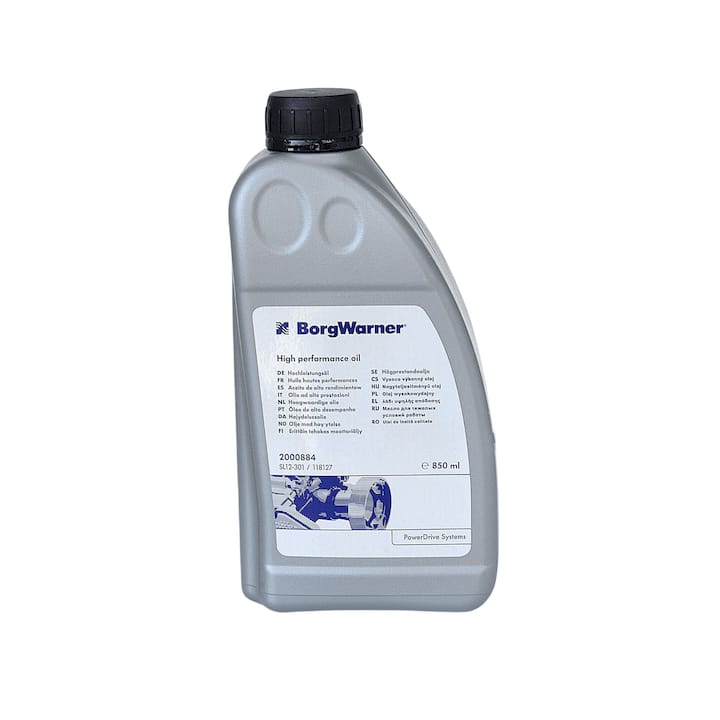
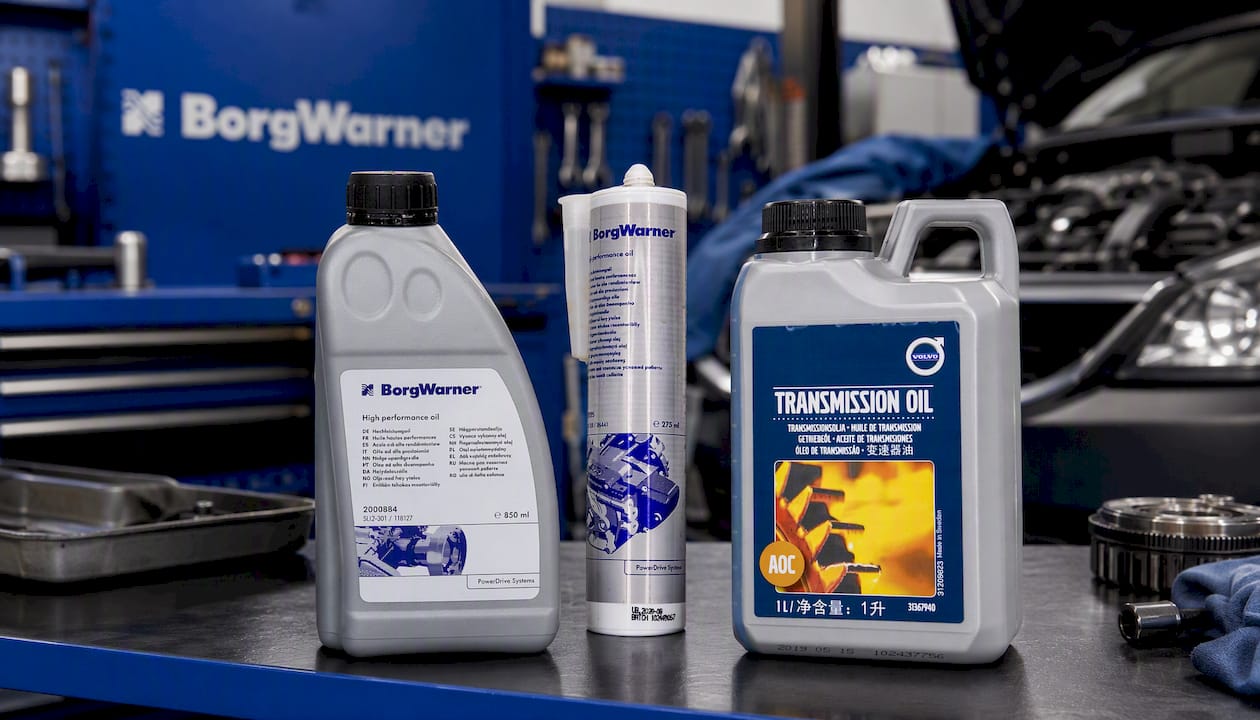
- Match the OE part number, not just the description. For 1st-generation systems, the correct fluid is the BorgWarner OEM Haldex Oil G052175A1 108295 (275ml) cartridge. For 2nd to 5th generation units, it’s the BorgWarner 850ml original high performance oil 2000884 (G060175A2).
- Watch for misleading OE labelling. Some genuine Volvo bottles print “transmission oil” on the label despite containing Haldex/AOC coupling fluid, a labelling quirk documented in owner discussions on the Volvo AOC fluid vs transmission oil thread. The genuine article is the Volvo AOC Haldex transmission oil, part 31367940.
- Check nozzle fit before you pour. Some aftermarket bottles need the nozzle trimmed to seat properly in the coupling’s fill port; forcing an ill-fitting nozzle risks spillage or air ingestion.
What to do if the wrong fluid has already gone in
Finding out too late is common, and the fix depends on how long the wrong fluid has been circulating and under how much load.
- Stop driving and identify the fluid. Check the bottle, invoice, or workshop paperwork for exactly what was used, and photograph anything ambiguous before it’s binned.
- Drain and flush, don’t just drain. Publisher guidance from Haldexparts is clear that a single drain-and-refill often leaves contaminated residue behind. A proper solvent flush clears additive traces that a straight drain misses.
- Replace the filter where fitted, then refill with the correct OEM fluid matched to your generation, and prime the pump per the service procedure rather than just topping up and driving off.
- Inspect the clutch pack if symptoms were present before the flush. Contamination that’s caused visible shudder or noise may have already glazed the friction surfaces, and a fluid change alone won’t fix that; a workshop can assess wear during disassembly.
- Escalate to a specialist if noise, slip, or delayed engagement persists after a flush and correct refill. That combination usually points to pump or clutch pack damage rather than remaining fluid contamination.
Pro Tip: Keep the drained fluid in a sealed container until the fix is confirmed. If a workshop later disputes what was used, it’s your evidence.
Expect the range of outcomes to vary with how long the contamination sat: caught within days, a flush and correct refill is often enough. Left for weeks under normal driving, clutch pack replacement becomes a realistic possibility, a pattern borne out in the remediation cases discussed in owner forums.
Getting the right Haldex fluid stocked and specified
Mindaugas and the team at HaldexParts.co.uk work specifically with Haldex service parts across Audi, VW, Ford, Land Rover, and Volvo, which means every fluid listed is mapped to a generation and OE part number rather than sold as a generic “AWD fluid.”
The current range covers the situations owners actually run into:
- BorgWarner 850ml oil 2000884 (G060175A2) for 2nd to 5th generation systems, the most common fitment on newer Audi and VW models.
- BorgWarner OEM Haldex Oil G052175A1 108295 (275ml) for early 1st-generation units, sold in the smaller cartridge format those systems need.
- Volvo AOC Haldex transmission oil 31367940 for Volvo-specific applications, where the OE label wording causes the most confusion.
For the flushing procedure itself, the guide on why upgraded Haldex oil matters for AWD performance and the breakdown of what causes Haldex oil to degrade both walk through the mechanics in more depth than fits here.
Why the “any AWD fluid will do” advice keeps causing repairs
The advice that keeps circulating online, that any red fluid or generic AWD oil will work in a pinch, survives because Haldex systems often tolerate the wrong fluid for weeks before failing outright. That delay is exactly what makes it dangerous. Owners top up with whatever’s in the garage, nothing goes wrong for a month, and the substitution gets treated as harmless.
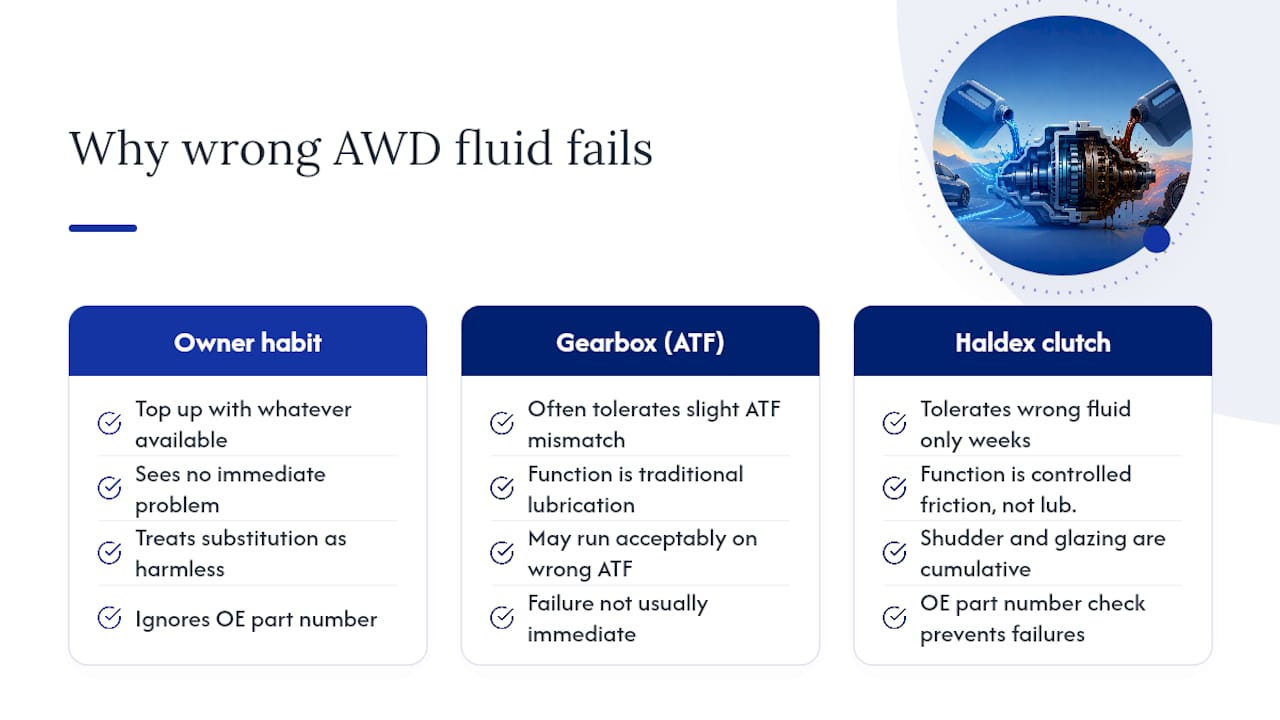
What the forum evidence and product data actually show is narrower and more useful: the fluid’s job isn’t lubrication in the traditional sense, it’s controlled friction under hydraulic pressure, and that’s a much smaller tolerance window than most owners assume. A gearbox will often run acceptably on a slightly wrong ATF spec. A Haldex clutch pack won’t, because shudder and glazing are cumulative, not sudden.
If there’s one thing worth prioritising over everything else in this article, it’s the OE part number check before any fluid goes near the coupling, not the brand, not the colour, not the word printed on the bottle. Labelling inconsistency, particularly on Volvo AOC products, means the part number is the only reliable identifier. Get that right first and most of the failure modes described here simply don’t happen.
— Mindaugas
Buying the correct Haldex oil and service kit
Choosing an OEM-grade fluid over a generic substitute is the single biggest lever you have over how long a Haldex system lasts.
Start by confirming your Haldex generation, then order the matching part rather than guessing from bottle colour or price. Gen 2 to 5 owners want the BorgWarner 850ml oil 2000884 (G060175A2), 1st-generation owners need the BorgWarner OEM Haldex Oil G052175A1 108295, and Volvo owners should look specifically for the Volvo AOC Haldex transmission oil 31367940 rather than a generic transmission fluid with a similar label. If you’re doing a full service rather than just a top-up, pairing the fluid with a pump and filter kit in the same order avoids a second wait on parts halfway through the job, and orders over £150 ship free. Browse the fluid matched to your vehicle and get the part number confirmed before you buy.
Sources
For fluid specification detail beyond this guide, the Ravenol AWD-H Haldex fluid data page covers viscosity and friction figures directly. Real-world contamination cases and remediation outcomes are documented in the BobIsTheOilGuy differential fluid thread and the Audi TT Forum rear Haldex oil discussion.
- Differential Fluid used Instead of Haldex Fluid