
Ford Haldex compatible components are specialised parts designed to maintain and restore the performance of Ford vehicles equipped with Haldex all-wheel-drive systems. The term covers everything from oil pumps and coupling filters to control units and seal repair kits. Getting the right part is not simply about brand preference. Each Haldex generation uses unique hardware that is not interchangeable across generations, and fitting the wrong component causes system faults, accelerated wear, and costly repairs. This guide lists the ten most critical ford haldex system parts, explains which Ford models they fit, and shows you how to verify compatibility before you order.
1. What are Ford Haldex compatible components?
Ford Haldex compatible components are parts built or certified to work within the Haldex electronically controlled coupling fitted to Ford AWD vehicles. The industry term for the broader system is the Haldex AWD coupling, and it operates by using hydraulic pressure to engage the rear axle when the front wheels slip. Key component categories include oil pumps, coupling oil, oil filters, control units, seal kits, and clutch packs. Each category contains generation-specific variants, so a part listed for a Gen 3 system will not function correctly in a Gen 4 or Gen 5 vehicle.
2. Haldex oil pumps for Ford Kuga and Transit
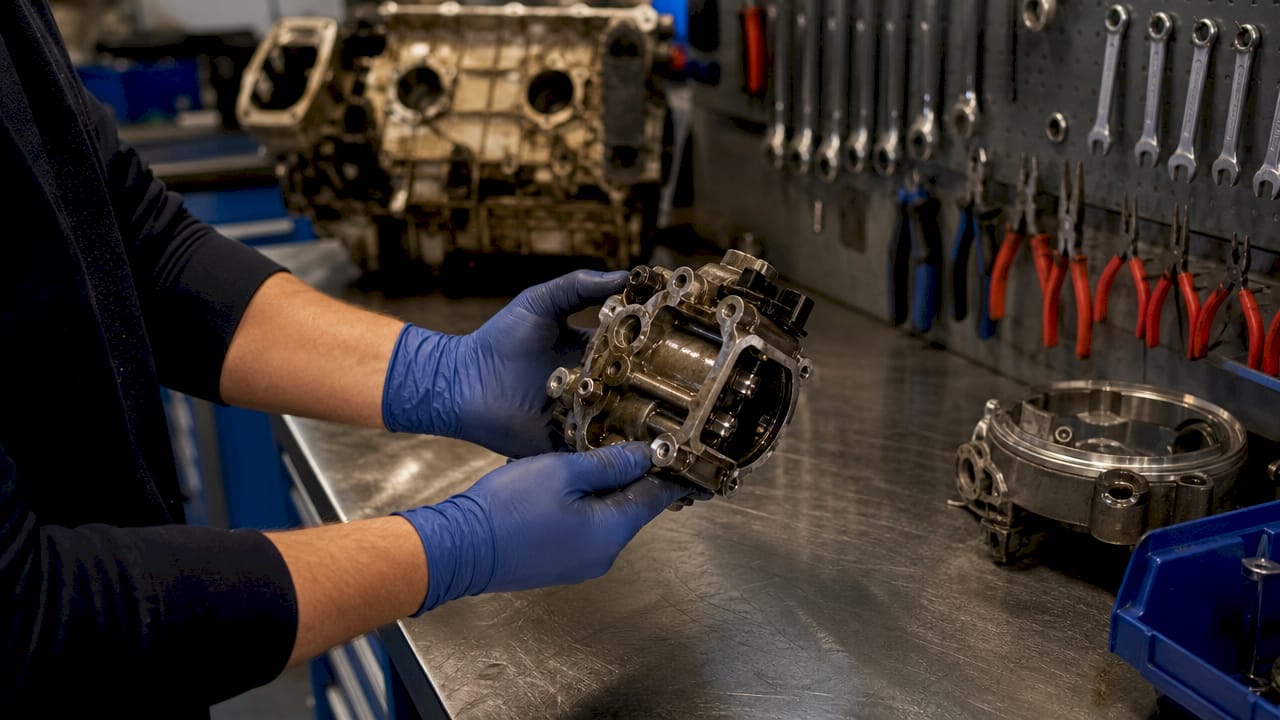
The oil pump is the heart of the Haldex coupling. It builds the hydraulic pressure that engages the rear axle, so a worn or mismatched pump directly reduces AWD response. Ford model-specific pumps vary by year and chassis. The Ford Kuga Mk1 (2008–2012) uses the LSC 31256757 pump, while the Ford Transit Mk7 (2013–2018) requires the LSC LR051321 pump. These two part numbers are not interchangeable, even though both vehicles use Haldex-based AWD systems.
Pro Tip: Always cross-reference the part number on your existing pump before ordering a replacement. The casting number is stamped on the pump body and matches the OEM catalogue reference.
3. Ford AWD coupling oil
Coupling oil is the most frequently neglected Ford Haldex system part. The fluid lubricates the clutch pack and carries hydraulic pressure, so degraded oil causes slipping and overheating. Official Ford-branded Haldex coupling oil is supplied in 300ml containers and is formulated specifically for Ford AWD-2 systems such as the Kuga Mk2 (2013–2016). Using a generic differential oil instead of the correct OEM fluid causes functional issues because the friction modifiers differ. You can browse the full range of Haldex coupling oils to confirm the correct specification for your model.
4. Haldex oil filters for Ford Kuga AWD
The oil filter prevents metallic debris from the clutch pack from circulating through the pump. A blocked or incorrect filter starves the pump of clean fluid and accelerates wear. The BorgWarner Haldex filter 8V41-4A319-AA is a genuine filter for the Ford Kuga AWD (2008–2009), and it is a clear example of how model-specific and year-specific filter codes are. Fitting a filter from a different generation changes the flow restriction and can trigger fault codes. The dedicated range of Ford AWD oil filters lists filters by model and year to remove guesswork.
5. Complete service kits for Ford Haldex systems
A service kit bundles oil, filter, seals, and drain or fill bolts into a single matched set. Haldex service kits provide all the parts needed for a complete service in one purchase, which removes the risk of mixing components from different batches or generations. Buying individual parts separately increases the chance of a mismatch. A kit designed for the Ford Kuga Gen 3 system, for example, contains the correct O-ring dimensions and oil volume for that specific coupling.
6. Haldex control units and electronic components
The control unit reads wheel speed sensors and commands the pump to build pressure. Without a functioning unit, the AWD system defaults to front-wheel drive only. Control units must match the Haldex generation and the vehicle chassis number, because Gen 1 through Gen 5 units differ in both connector type and software protocol. A Gen 4 control unit fitted to a Gen 2 system will not communicate correctly with the pump. When replacing a control unit, always supply the VIN to the parts supplier so they can confirm the correct variant.
7. Seal and clutch repair kits for Gen 4 and Gen 5 systems
Seal kits address the most common cause of Haldex pump failure: worn O-rings that allow hydraulic pressure to bleed off. A Gen 5 seal repair kit includes new seals and the correct coupling oil in a single package. Clutch packs, or steel friction plates, wear gradually and reduce torque transfer to the rear axle. Steel friction plates for Gen 4 and Gen 5 are sold as matched sets of ten discs. Fitting mismatched plates from a different generation changes the clamping force and upsets the calibration of the control unit.
8. Ford AWD pump motors
The pump motor drives the pre-charge pump electrically. When the motor fails, the pump cannot build pressure before wheel slip occurs, so AWD engagement is delayed or absent. Ford AWD pump motors are listed by vehicle model and system generation, because the motor voltage and connector pinout differ across the range. Replacing only the motor rather than the full pump assembly is a cost-effective repair when the pump body and seals are still serviceable.
9. Pressure relief valves and performance hardware
Pressure relief valves regulate the maximum hydraulic pressure inside the coupling. Fitting a valve with the wrong pressure rating causes either premature clutch engagement or insufficient torque transfer. Performance software upgrades for Gen 5 systems depend on compatible hardware, and attempting a software tune without the correct pressure relief valve causes premature wear. OEM replacement valves retain the factory pressure calibration and are the safest choice for vehicles not running a matched performance package.
10. How to verify Ford Haldex component compatibility
Compatibility verification is the step most technicians skip, and it is the most expensive mistake to make. Parts are not interchangeable across Haldex generations, and the generation fitted to your Ford is not always obvious from the model name alone. Use this process before ordering any component:
- Locate the VIN on the vehicle identification plate, usually on the door sill or bulkhead.
- Decode the VIN using Ford’s official parts catalogue or a trusted supplier’s compatibility tool to confirm the exact model year and specification.
- Identify the Haldex generation from the decoded vehicle data. Gen 3 and Gen 4 are the most common in Ford Kuga models; Transit AWD variants typically use Gen 4.
- Cross-reference the OEM part number on the component you are replacing against the supplier’s catalogue for that generation.
- Confirm the part number with the supplier before checkout, supplying the VIN if the catalogue lists multiple options.
Pro Tip: If you are unsure of the generation after decoding the VIN, photograph the existing pump or control unit and send the image to your supplier. The casting marks and connector shape identify the generation immediately.
How Haldex generations affect component selection
The Haldex system evolved through five generations, and each introduced changes that affect which parts fit. The table below summarises the key hardware differences relevant to Ford vehicles.
| Generation | Pump type | Filter location | Control unit | Common Ford fitment |
|---|---|---|---|---|
| Gen 3 | Pre-charge pump, external motor | External, inline | Separate ECU | Kuga Mk1 (early) |
| Gen 4 | Integrated pump and motor | Internal, within housing | Integrated module | Kuga Mk1 (late), Transit Mk7 |
| Gen 5 | Revised integrated pump | Internal, revised port | Updated integrated module | Kuga Mk2 (some variants) |
Identifying the exact generation via VIN before ordering prevents the most common and costly fitment errors. Gen 4 repair sets are not compatible with Gen 2 or Gen 5 systems, and the wrong oil specification causes functional faults regardless of generation.
Maintenance components and Haldex system upgrades
Routine maintenance is the single most effective way to extend the life of a Ford Haldex AWD system. The core service items are coupling oil, the oil filter, and O-ring seals. A full Haldex service requires cleaning the pump gauze filter as well as replacing the oil and external filter. This step is frequently overlooked, and a blocked gauze starves the pump of flow even when the external filter is new.
For technicians considering Haldex system upgrades, the rule is straightforward: hardware and software must be matched. OEM-quality parts retain the factory safeguards built into the control unit’s pressure map. Performance parts from tuning specialists such as APR are designed as complete packages, not individual components. Fitting a performance pump without the corresponding software calibration shifts the pressure curve outside the control unit’s expected range.
Budget aftermarket parts are appropriate for low-mileage or older vehicles where OEM parts are no longer available. For any Ford Kuga or Transit AWD system still in regular use, OEM-grade components from a specialist supplier are the correct choice.
Key takeaways
Selecting the correct Ford Haldex compatible components requires matching each part to the specific vehicle model, year, and Haldex generation, because no component is universal across the Gen 1 to Gen 5 range.
| Point | Details |
|---|---|
| Generation matching is non-negotiable | Pumps, filters, oils, and control units differ across Gen 1–5 and cannot be swapped between generations. |
| VIN verification prevents costly errors | Always decode the VIN before ordering to confirm the exact Haldex generation fitted to your Ford. |
| Service kits reduce mismatch risk | Buying a matched service kit guarantees that oil, filter, and seals are all specified for the same system. |
| Pump gauze cleaning is part of every service | Replacing the oil and filter without cleaning the pump gauze leaves a blockage that accelerates pump wear. |
| OEM-grade parts protect system longevity | Genuine or OEM-quality components retain the factory calibration that aftermarket parts often compromise. |
Why I always start with the generation, not the model name
After years of working with Haldex AWD systems across Ford, Audi, and Land Rover vehicles, the single most consistent source of problems I see is technicians ordering parts by model name rather than generation. A Ford Kuga is not one vehicle from a Haldex perspective. The Mk1 alone spans Gen 3 and Gen 4 hardware depending on the build date, and the control unit connector changed between those generations. I have seen workshops fit a Gen 4 pump to a Gen 3 housing and wonder why the system throws fault codes within a week.
The Haldex AWD system is genuinely well-engineered, but it is unforgiving of incorrect parts. The coupling relies on precise hydraulic pressure, and even a small deviation from the specified oil viscosity or filter flow rate upsets the balance. My advice is always the same: decode the VIN first, identify the generation second, then order. Suppliers like Haldexparts list parts by generation and model, which removes the ambiguity entirely.
The other mistake I see regularly is skipping the pump gauze clean during a service. Owners replace the oil and filter, feel satisfied, and then wonder why the pump fails eighteen months later. The gauze is inside the pump housing and collects fine metallic particles that the external filter does not catch. Cleaning it adds ten minutes to a service and extends pump life significantly. If you are servicing a Ford Haldex system, that step is not optional.
— Mindaugas
Haldexparts: your source for Ford Haldex parts
Haldexparts stocks OEM-grade components for Ford Haldex AWD systems, listed by model, year, and generation so you can confirm compatibility before you buy.
The range covers Ford Haldex service kits with matched oil, filters, and seals, plus individual components including AWD pump motors and Haldex oil pumps for specific Ford models. Orders over £150 qualify for free shipping. The product pages include part number references and vehicle fitment data, so both DIY owners and professional technicians can verify the correct component quickly. If you need guidance on a specific Ford model or generation, the Haldexparts team provides direct support before and after purchase.
FAQ
What Ford models use a Haldex AWD system?
The Ford Kuga Mk1 and Mk2 are the most common Ford models fitted with Haldex AWD couplings, alongside the Ford Transit Mk7 in AWD specification. Other Ford AWD models may use different coupling systems, so always verify via the VIN.
Are Haldex parts interchangeable between generations?
No. Haldex components are generation-specific, and fitting a part from the wrong generation causes system faults and accelerated wear. Always confirm the generation before ordering.
How often should I service a Ford Haldex system?
Most Ford Haldex systems require an oil and filter service every 30,000–40,000 miles or every two years, whichever comes first. A full service also includes cleaning the pump gauze filter and inspecting the O-ring seals.
Can I use generic differential oil in a Ford Haldex coupling?
No. Ford AWD-2 systems require OEM-specified coupling oil formulated with the correct friction modifiers. Generic differential oil causes clutch slipping and can damage the coupling permanently.
How do I find the correct Haldex part number for my Ford?
Decode your VIN using Ford’s parts catalogue or a specialist supplier’s compatibility tool to identify the model year and Haldex generation. Then cross-reference the OEM part number on the component you are replacing against the supplier’s generation-specific listing.