

Haldex limits power delivery to the rear axle by design, using a software-controlled hydraulic clutch that modulates torque transfer based on real-time sensor inputs from the ABS, ESP, and engine control units. This is not a flaw. The system deliberately caps rear torque to protect driveline components, maintain vehicle stability, and extend clutch pack life. Understanding why Haldex affects performance this way requires looking at both the software logic and the physical hardware constraints that govern every generation of the system.
Why Haldex limits power delivery: software and hardware by design
The core reason Haldex limits power delivery is that software, not hardware capacity, is the primary constraint. Factory-default Gen 5 units limit rear torque to roughly 30% during standard acceleration, even though the pump hardware is physically capable of generating far greater clutch pressure. That gap between hardware capability and software permission is intentional.
The pump itself is shared with high-power platforms and carries a torque rating well beyond typical passenger car demands. Software is the gatekeeper. The control module receives inputs from the CAN bus, including data from the ABS and engine management systems, and uses predictive algorithms to decide how much hydraulic pressure to generate at any given moment.
Three core priorities drive the software logic:
- Vehicle stability: The ESP and ABS systems feed real-time wheel speed data to the Haldex controller. If full rear torque would cause oversteer or loss of traction, the system reduces clutch pressure immediately.
- Fuel economy: Maintaining high hydraulic pressure continuously draws electrical power. The software relaxes torque transfer during steady cruising to reduce parasitic load.
- Driveline protection: Sustained high clutch pressure generates heat and accelerates wear on the friction material. The software limits duty cycles to extend service intervals.
This Haldex power management approach means the system behaves more like a stability tool than a performance device in stock form.
How Haldex generations evolved their power delivery limits
The shift from mechanical to software-driven control is the defining story of Haldex system development. Generation 1 and 2 systems required front-wheel slip before the rear axle engaged at all. The clutch pressure was generated mechanically by the speed difference between the front and rear prop shafts. This reactive approach meant there was always a delay before power reached the rear wheels.
| Generation | Engagement method | Control type | Key limitation |
|---|---|---|---|
| Gen 1–2 | Mechanical slip detection | Reactive hydraulic | Rear engages only after front slip |
| Gen 3–4 | Electric pump, basic ECU | Semi-predictive | Limited sensor integration |
| Gen 5 | Electric pump via CAN bus | Fully predictive software | Software caps torque at ~30% |
Generation 3 and 4 units introduced an electric pump, which removed the dependency on mechanical slip. The pump could pre-charge the clutch pack before slip occurred, reducing engagement delay. Control logic became more sophisticated, but sensor integration remained limited compared to what followed.
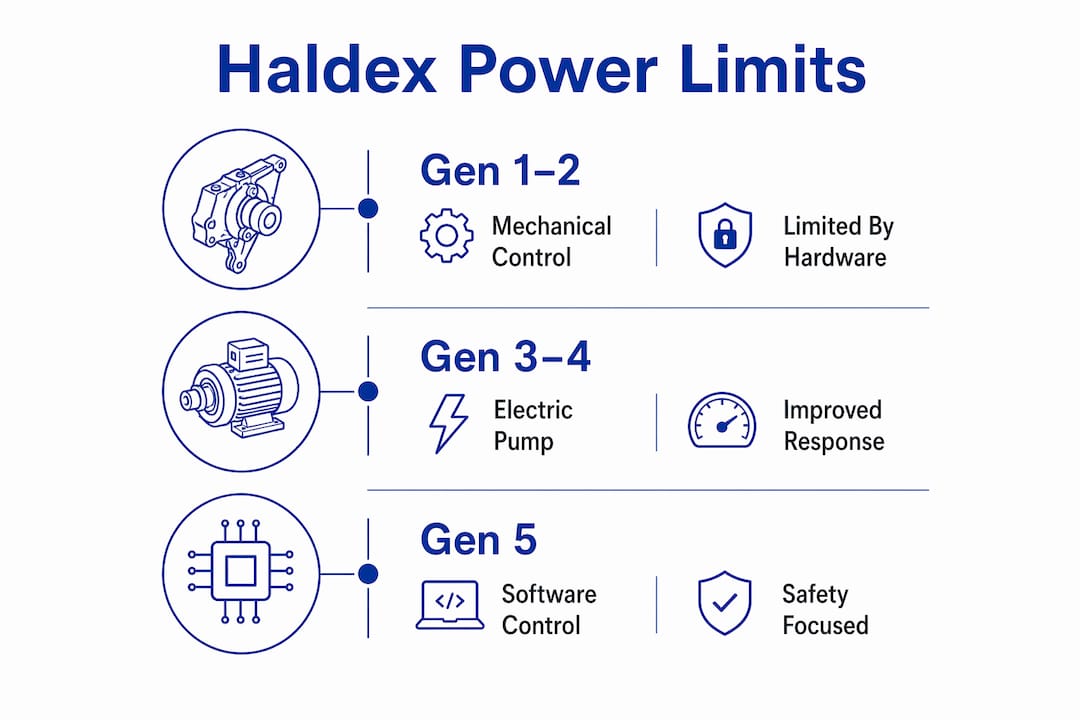
Generation 5 is the current standard in VAG Group vehicles including Audi, VW, Skoda, and Seat models. The pump runs entirely on CAN bus commands. The control module acts as a subordinate node on the drivetrain network, receiving inputs from ABS, engine management, and ESP before deciding how much torque to send rearward. This architecture gives the system genuine predictive capability. It also means the software can impose tighter limits with greater precision than any earlier generation could manage.
The practical result of this evolution is that Gen 5 systems respond faster but are more conservatively tuned from the factory. The hardware headroom exists. The software simply does not use it by default.
Why factory software restricts rear-axle torque in Gen 5 units
The Gen 5 control module treats torque distribution as a safety function first and a performance function second. Software prioritises stability, fuel economy, and driveline protection over maximum torque transfer, which is why the rear axle rarely receives more than 30% of available torque under normal driving conditions.
The pump motor’s electrical characteristics also play a role. The controller monitors current draw from the pump motor continuously. If current draw falls outside expected parameters, the module interprets this as a fault condition and reduces power delivery as a protective response. This means the software limit is not a fixed ceiling. It adjusts dynamically based on what the controller believes the hardware can safely handle at any given moment.
Key software-imposed constraints in Gen 5 systems include:
- Clutch pack duty cycle limits: The software prevents sustained high-pressure engagement to avoid overheating the friction material.
- Pump motor current thresholds: The controller caps pump output if current draw suggests motor stress or winding degradation.
- ESP override authority: Stability control inputs can reduce rear torque to zero within milliseconds, regardless of driver demand.
- Fuel economy mode: During light-load cruising, the system defaults to front-wheel drive to reduce electrical consumption.
Pro Tip: If your diagnostic tool shows clutch pressure within normal range but the rear axle feels unresponsive, check pump motor winding resistance. A healthy pump motor reads 5–8 ohms. A reading below 2 ohms indicates winding failure, which causes the controller to suppress torque delivery even when pressure readings appear normal.
Understanding Haldex torque distribution at the software level is the first step toward diagnosing whether a limitation is intentional or a symptom of a developing fault.
Electrical and hydraulic factors that physically restrict power delivery
Software limits explain the factory ceiling, but physical degradation can push the effective limit even lower. The interplay between electrical health and hydraulic performance is where most real-world power delivery problems originate.
- Pump motor winding resistance rises with age. As the motor degrades, current draw drops. The controller interprets low current as low pump performance and reduces the power supply to the motor, compounding the problem.
- Corroded connectors reduce voltage at the pump. Weak power supply causes the pump to underperform hydraulically. The controller sees the reduced output and restricts power delivery as a safety measure, even if the motor itself is electrically sound.
- Clogged oil passages restrict hydraulic flow. Contaminated Haldex oil deposits debris in the valve body and clutch feed galleries. Reduced flow means lower clutch pressure regardless of pump output.
- Worn clutch friction material reduces torque capacity. Even if full hydraulic pressure is present, worn friction plates cannot transfer the torque the pressure is designed to produce.
- Diagnostic pressure readings can mislead. Gen 5 systems calculate clutch pressure from pump motor current draw, not from a physical pressure sensor. A mechanically blocked system can show normal software-estimated pressure while delivering almost no actual clutch force.
Pro Tip: After replacing a Gen 5 pump, always run the adaptation procedure using VCDS or a compatible diagnostic tool. The control module must learn the new pump’s current draw profile before it will supply correct power levels. Skipping this step causes persistent underperformance and may trigger fault codes that point to the wrong component.
For a detailed breakdown of how electrical faults affect hydraulic performance, the diagnostic process requires checking both domains before condemning any single component.
How power delivery limits affect driving dynamics and performance
The practical effect of Haldex power management on driving feel is most obvious during hard acceleration from a standstill. In stock Gen 5 form, the rear axle engages after the front wheels have already begun to pull the car forward. The delay is short but perceptible, particularly on low-grip surfaces. Enthusiasts often describe this as the system feeling “lazy” compared to a mechanical centre differential.
Partial torque limits also influence cornering behaviour. When the rear axle receives less torque than the front, the vehicle tends toward understeer. This is the intended handling balance for most road cars, but it conflicts with what performance-oriented drivers want from an AWD platform.
Software tuning can alter the responsiveness and maximum torque transfer of the system by recalibrating the pressure maps and engagement thresholds within the control module. Recalibrated software leads to faster and more assertive clutch engagement, improving rear torque bias during launches and reducing the perceived delay on corner exit.
The trade-offs are real, however:
- Increased clutch wear: Higher sustained pressure accelerates friction material degradation, shortening service intervals.
- Greater heat generation: More aggressive engagement cycles raise operating temperatures, which degrades Haldex oil faster.
- Reduced ESP authority: Some tuning solutions modify the relationship between the Haldex controller and the ESP module, which can affect stability control response.
- Warranty implications: Any software modification outside factory parameters voids the drivetrain warranty on vehicles still covered.
For technicians, understanding torque monitoring logic helps distinguish between a vehicle that is performing to its factory specification and one that has a genuine fault suppressing rear torque below the intended limit.
Key takeaways
Haldex limits power delivery primarily through software constraints, not hardware capacity, with Gen 5 units capping rear torque at roughly 30% to protect driveline components and maintain vehicle stability.
| Point | Details |
|---|---|
| Software is the primary limiter | Gen 5 hardware can handle far more torque than factory software permits under normal conditions. |
| Electrical faults mimic hydraulic failures | Corroded connectors and weak power supply cause the controller to restrict torque as a safety response. |
| Adaptation after pump replacement is critical | Skipping the adaptation procedure causes persistent underperformance and misleading fault codes. |
| Diagnostic pressure values are estimates | Gen 5 systems calculate clutch pressure from motor current, not physical sensors, which can mask real blockages. |
| Tuning increases performance but adds wear | Software recalibration improves rear engagement speed but shortens clutch and oil service intervals. |
Why I think most technicians diagnose Haldex backwards
After working through a significant number of Haldex faults across VAG Group vehicles, the pattern I see most often is technicians starting with the hydraulics and ignoring the electrical supply. The Gen 5 system’s biggest diagnostic trap is that it presents hydraulic symptoms when the root cause is electrical. A corroded ground strap or a failing pump connector drops voltage at the motor. The motor underperforms hydraulically. The controller reads low current, assumes the pump is struggling, and suppresses torque delivery. The technician sees low rear engagement and replaces the pump. The new pump goes in without adaptation. The fault persists. The clutch pack gets blamed next.
The correct sequence is always electrical first: check supply voltage at the pump connector under load, measure winding resistance, inspect the ground path. Only then move to hydraulic assessment, and remember that the pressure figure your diagnostic tool displays is a software estimate derived from motor current, not a reading from a physical transducer. A system can show 40 bar on screen while delivering almost nothing to the clutch because a blocked gallery is starving the circuit.
The generational context matters too. If you are working on a Gen 1 or Gen 2 unit and the rear axle is slow to engage, the fix is almost always mechanical. If you are on Gen 5, assume software and electrical until proven otherwise. That mental shift alone saves hours of unnecessary component replacement.
Understanding the Haldex AWD system at the architectural level, not just the component level, is what separates a technician who fixes it correctly the first time from one who replaces parts until the symptom goes away.
— Mindaugas
Genuine Haldex parts to maintain optimal power delivery
Keeping a Haldex system performing to its design specification starts with the right service components. Contaminated oil, a worn filter, or a degraded pump motor all push the system toward its protective limits faster than normal driving ever would.
Haldexparts stocks OEM-grade Haldex service kits covering pumps, oils, and filters for Audi, VW, Skoda, Seat, Ford, Land Rover, and Volvo applications. Each kit is matched to the specific generation and vehicle model, so you get the correct specification without guesswork. Orders over £150 qualify for free shipping, and the product listings include the technical detail technicians and enthusiasts need to confirm fitment before ordering. If you are sourcing a replacement AWD pump or the correct Haldex oil for a service interval, Haldexparts is the specialist source trusted by workshops and DIY technicians across the UK.
FAQ
What does Haldex limit rear torque to in standard form?
Gen 5 Haldex units limit rear torque to approximately 30% during normal acceleration. The hardware is capable of significantly higher torque splits, but factory software caps output to protect driveline components and maintain stability.
Why does Haldex feel slow to engage on acceleration?
Early Haldex generations required front-wheel slip before the rear axle engaged. Gen 5 systems use predictive software, but factory pressure maps are conservative, which creates a perceptible delay during hard launches that tuning can reduce.
Can electrical faults cause Haldex to limit power delivery?
Yes. Weak supply voltage or corroded connectors cause the pump to underperform, and the controller interprets this as a hardware fault and restricts torque delivery as a protective response, even when the clutch pack itself is in good condition.
Do I need to run an adaptation after replacing a Haldex pump?
Adaptation is mandatory. The control module must learn the new pump’s current draw profile to supply correct power levels. Skipping the procedure causes underperformance and fault codes that point to the wrong component.
Does Haldex tuning permanently increase rear torque?
Software recalibration raises the clutch pressure ceiling and reduces engagement delay, delivering more rear torque during acceleration. The trade-off is faster clutch wear and more frequent oil changes, so service intervals must be shortened accordingly.