

Haldex engagement speed is the time and rate at which the Haldex coupling applies torque to the rear axle after the control unit decides intervention is needed. It has two measurable components: latency (the delay in milliseconds from trigger event to first measurable clutch pressure) and torque ramp rate (how quickly clamping force builds once the clutch begins to close). Modern Haldex generations engage proactively before wheels visibly slip, using pre-charge pump actuation and ECU algorithms to keep latency low.
- Early generations (Gen I/II): reactive architecture, latency in the hundreds of milliseconds range, torque ramp relatively gradual
- Later generations (Gen III/IV/V and AOC variants): proactive pre-charge pump keeps the system primed; latency drops significantly, torque ramp is sharper
- Practical implication: a system with degraded oil, a failing pump, or a blocked filter will feel sluggish off the line on snow or during hard acceleration, with the rear axle noticeably late to contribute
If your car feels like it launches on front-wheel drive alone before the rear catches up, slow engagement is the likely culprit.
Table of Contents
- What does Haldex engagement speed actually measure?
- How the Haldex system controls engagement speed
- How engagement speed changed across Haldex generations
- How engagement speed feels on the road, and the myths worth correcting
- How maintenance and faults affect engagement speed
- How to test and measure engagement speed
- Can software tuning change engagement speed?
- Key takeaways
- A technician’s perspective on what actually goes wrong
- OEM-grade Haldex service kits, delivered to your door in the UK
- Useful sources for further reading
What does Haldex engagement speed actually measure?
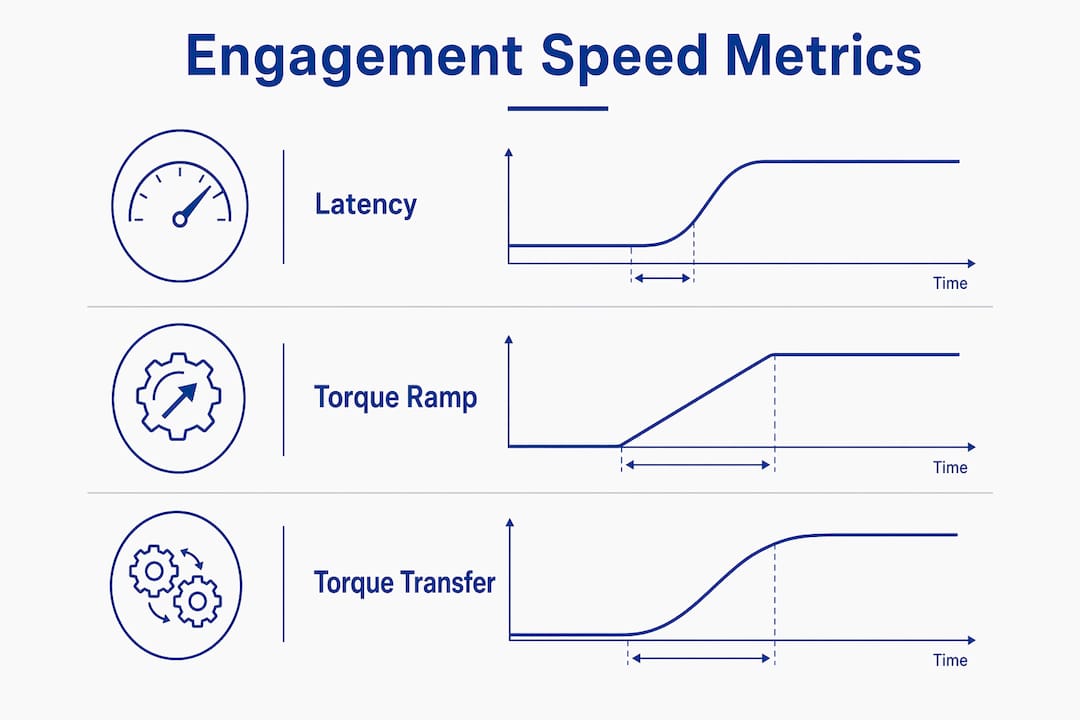
The phrase “engagement speed” covers three distinct metrics that technicians should track separately.
Latency is the elapsed time between the trigger event (an ABS yaw signal, a throttle threshold crossing, or a wheel-speed delta) and the moment the clutch pack registers its first non-zero pressure. You record it from CAN logs by timestamping the initial engagement request and the first pressure reading from the hydraulic circuit. The unit is milliseconds.
Torque ramp rate describes how steeply clutch clamping force increases once engagement begins. A fast ramp means the rear axle receives meaningful torque within a short window; a slow ramp means the system creeps up to its target pressure over a longer period. The hydraulic side is measured in bar or psi; the torque side in Nm or as a percentage of total available torque.
Total torque transfer is the peak percentage of drive directed to the rear axle at full engagement. This varies by generation, vehicle tune, and driving condition rather than being a fixed figure.
| Metric | Unit | What it tells you |
|---|---|---|
| Latency | Milliseconds (ms) | Time from trigger to first clutch pressure |
| Torque ramp rate | Bar/s or Nm/s | Speed of pressure build-up in the clutch pack |
| Peak torque transfer | % of total drive | Maximum rear-axle contribution at full lock |
| Hydraulic working pressure | Bar or psi | Clutch clamping force at a given engagement level |
Keeping these three metrics distinct matters when diagnosing faults. A long latency usually points to an electrical or pump issue; a slow ramp with normal latency often indicates hydraulic restriction (blocked filter, degraded oil viscosity); a low peak transfer suggests a worn clutch pack or a software calibration limit.
How the Haldex system controls engagement speed
The Haldex control unit does not wait for wheel slip alone. It reads multiple inputs simultaneously and calculates the required clutch pressure before a slip event fully develops.
The main subsystems
- Wheel-speed sensors (G44–G47): detect speed deltas between front and rear axles and feed the ABS module, which forwards data to the Haldex ECU over CAN
- Engine management signals: throttle position, engine torque, and engine speed arrive via CAN; the pump activates as soon as engine speed exceeds 400 rpm
- Haldex ECU: processes all inputs, applies calibrated pressure maps, and commands the pump and solenoid valve
- Electric pre-charge pump: pressurises the hydraulic circuit so the clutch pack is already partially loaded when a demand signal arrives
- Solenoid valve: modulates oil flow to the working piston with millisecond precision
- Wet multi-plate clutch pack: converts hydraulic pressure into mechanical torque transfer to the rear axle
Signal flow
Sensor inputs arrive at the ECU → the ECU applies its pressure map → the pump motor is commanded to a target duty cycle → the solenoid valve meters oil to the working piston → the piston loads the clutch plates → torque transfers to the rear propshaft. The entire chain from sensor event to measurable clutch pressure is what produces the latency figure you read in a CAN log.
Software calibration parameters sit inside this chain. The ECU maps define how aggressively the pump responds to a given throttle or yaw input, how quickly pressure ramps, and at what road speed the system reduces clamping force to limit drivetrain drag. Changing those maps through tuning directly alters the engagement speed the driver experiences.
| Subsystem | Role in engagement speed | Failure effect |
|---|---|---|
| Wheel-speed sensors | Trigger signal source | Late or absent engagement request |
| Haldex ECU | Pressure map execution | Wrong ramp rate, no engagement |
| Pre-charge pump | Reduces latency by pre-loading circuit | High latency if pump fails |
| Solenoid valve | Pressure modulation | Erratic or absent ramp |
| Clutch pack | Converts pressure to torque | Low peak transfer if worn |
How engagement speed changed across Haldex generations
Each generation brought a meaningful shift in architecture, and that architecture directly sets the engagement characteristics you observe on a hoist or in a CAN log.
Generation I (1998–2002)
Purely reactive. The system waited for a measurable wheel-speed difference before commanding the pump. Latency was relatively high because the hydraulic circuit was not pre-loaded. Vehicles: original Audi TT, Audi S3 8L, VW Golf IV 4Motion.
Generation II (2002–2004)
Introduced an electronically controlled permanent 4×4 mode with the Haldex differential calculating rear-axle drive continuously. Under normal conditions 95% of power goes to the front axle, but the system monitors slip more actively than Gen I. Latency improved modestly.
Generation III (2004–2007)
Added a small auxiliary electric pump that pre-pressurises the system so torque transfer can occur almost instantly on demand. This is the architectural shift that moved Haldex from reactive to proactive behaviour. Latency dropped noticeably compared with Gen I/II.
Generation IV (2007–2012)
Refined ECU logic, faster solenoid response, and improved pump efficiency. VCDS Address 22 diagnostics became the standard tool for reading pressure and duty-cycle values on these units. The pre-charge pump cycles briefly at startup to keep the circuit primed. Vehicles include VW Tiguan, Audi Q3, Seat Alhambra, Škoda Yeti.
Generation V / AOC / PreX (2012 onwards)
BorgWarner TorqTransfer Systems took over distribution of the Gen V coupling. The new electro-hydraulic actuator uses a centrifugal overflow valve design, eliminating the accumulator, solenoid valve, and separate filter of earlier generations. The integrated ECU and revised pump architecture deliver the fastest engagement of any Haldex generation. Land Rover Freelander 2 and Range Rover Evoque use the AOC (Active On-Demand Coupling) variant, which shares the same proactive philosophy.
| Generation | Architecture | Engagement character | Key vehicles |
|---|---|---|---|
| Gen I | Reactive, slip-triggered | Highest latency | Audi TT, S3 8L, Golf IV |
| Gen II | Semi-proactive, continuous monitoring | Moderate latency | Golf IV 4Motion, Bora |
| Gen III | Pre-charge pump added | Low latency, proactive | A3, Leon, Octavia |
| Gen IV | Refined ECU, faster solenoid | Very low latency | Tiguan, Q3, Yeti |
| Gen V / AOC | Integrated ECU, no accumulator | Lowest latency | Crafter II, Freelander 2, Evoque |
How engagement speed feels on the road, and the myths worth correcting
What fast vs slow engagement actually feels like
A well-maintained Gen IV or Gen V system is nearly imperceptible in normal driving. On a snowy start, the rear axle loads up before the fronts have time to spin; the car simply goes. On a dry, hard-acceleration launch, you feel a planted, four-square sensation rather than a brief front-wheel scrabble. Mid-corner, the system can add rear torque to correct understeer before the driver has consciously registered the push.
A slow-engagement system tells a different story. The fronts spin briefly, the car yaws slightly, and then the rear catches up. On ice, that delay is enough to lose a straight-line launch. In a fast corner, the intervention arrives too late to be useful.
The myths
“Haldex is permanent 4WD.” It is not. Haldex operates primarily as front-wheel drive until sensors dictate torque transfer. The rear axle is disengaged under light, steady-state cruising to reduce fuel consumption and drivetrain drag.
“The torque split is fixed at 50/50.” Completely wrong. Torque distribution is variable and continuous, ranging from near 100% front to roughly 50/50 at maximum engagement, with every point in between available depending on the ECU’s pressure map and the driving condition.
“If AWD activates only occasionally, something is broken.” Infrequent engagement is normal. Manufacturer tuning means engagement frequency and aggressiveness vary by model. An S3 and a Tiguan with the same generation hardware will engage differently because their ECU maps are different.
How maintenance and faults affect engagement speed
Engagement speed degrades in three distinct ways: hydraulically, electrically, and through software. Each needs a different diagnostic path.
Hydraulic causes
- Degraded or contaminated oil: Haldex oil is a specific low-viscosity fluid. Standard gear oil destroys the clutch pack and raises viscosity, slowing pressure build-up. OEM-grade Haldex oil and regular changes are non-negotiable.
- Blocked filter: A clogged filter restricts flow to the pump, reducing working pressure and extending latency. Filters should be replaced at every oil service.
- Air ingress: Air in the hydraulic circuit compresses instead of transmitting pressure, producing a spongy, slow ramp.
- Seal leaks: Internal seal failure allows pressure to bleed off before the clutch fully loads.
Electrical causes
- Pump motor failure: No pump, no pre-charge pressure, no engagement. The pump motor is the single most common cause of complete AWD loss.
- Blown fuse or relay: Check the Haldex pump fuse before condemning the motor.
- Wiring fault or corroded connector: Intermittent pump activation produces inconsistent latency that can look like a hydraulic fault.
Service checklist
- Oil and filter: replace at the manufacturer’s recommended interval (typically every 40,000–60,000 miles or sooner if the fluid is dark or contaminated)
- Pump motor: inspect for noise, check activation voltage, bench test if pressures are low
- Seals and O-rings: inspect during pump removal; replace if any sign of weeping
- Connectors and fuse: clean and reseat the pump connector; verify fuse continuity
- ECU fault codes: clear stored codes after any mechanical repair and retest
Haldexparts stocks OEM-grade service kits covering oil, filter, and seals for Gen I through Gen V, including BorgWarner AOC kits for Land Rover and Ford applications. Replacement pump motors are listed by generation and vehicle model.
How to test and measure engagement speed
On-car hoist test
A raised-hoist test lets you confirm basic pump and clutch activity, but it has real limitations. With the vehicle on a four-post lift and all four wheels free to rotate, you can observe whether the rear wheels spin when the fronts are driven. What you cannot replicate is the lateral and longitudinal load the system uses to calculate engagement demand. A hoist test that shows rear-wheel rotation does not confirm correct engagement speed under road conditions.
Hoist procedure (Gen IV reference):
- Connect VCDS and open Address 22 (Haldex control module)
- Start the engine and let it idle above 400 rpm
- Observe pump duty cycle and working pressure values in live data
- Apply light throttle with the vehicle stationary; confirm pressure rises
- Note any fault codes stored in Address 22
Road test procedure
- Find a safe, low-traffic surface (a quiet car park or private road)
- Connect a CAN logger or VCDS with live data recording active
- From a standstill on a low-grip surface, apply moderate throttle
- Record the timestamp of the throttle threshold event and the first non-zero clutch pressure value
- Repeat three times and calculate a mean latency; consistent results indicate a healthy system, high variance suggests an intermittent fault
For a repeatable measurement, run the test at similar ambient temperatures and with the oil at operating temperature. Cold, thick oil will show longer latency than warm oil, which is normal behaviour rather than a fault.
Reading Address 22
VCDS Address 22 gives you pump duty cycle (%), working pressure (bar), and clutch engagement percentage in real time. Normal traces show pressure rising promptly with throttle input and dropping cleanly on lift-off. An abnormal trace shows delayed pressure rise (pump or filter fault), pressure that rises but does not hold (seal leak), or no pressure at all (pump motor or electrical fault).
Pro Tip: When logging from CAN, record the ABS yaw or wheel-speed delta event as your zero timestamp, not the throttle input. Throttle input precedes the ECU’s engagement decision by a variable margin depending on the pressure map, so using the yaw event gives you a cleaner latency figure.
Bench pump test
Remove the pump assembly and connect it to a 12V supply with an ammeter in series. A healthy pump motor draws current within its rated range and produces audible, consistent flow. High current draw with low flow indicates a seized or worn pump. No current draw points to an open-circuit motor winding or a failed brush.
| Diagnostic indicator | Likely cause |
|---|---|
| High latency, low pressure | Blocked filter or worn pump |
| Pressure rises but drops quickly | Internal seal leak |
| No pressure, pump audible | Solenoid valve fault |
| No pump activation | Blown fuse, wiring fault, or motor failure |
| Erratic pressure trace | Air ingress or intermittent connector |
The Haldex pressure sensor is worth checking independently if pressure readings from Address 22 look implausible; a faulty sensor can produce misleading traces without any underlying hydraulic fault.
Can software tuning change engagement speed?
Yes, and the effect can be substantial. Aftermarket Haldex controllers replace or supplement the OEM ECU’s pressure maps, allowing the user to adjust engagement aggressiveness, clamping pressure at different road speeds, and pre-charge behaviour. The Haldexparts tuning guide covers the practical steps in detail.
What aftermarket controllers typically change:
- Engagement threshold: how small a wheel-speed delta or throttle input triggers the pump
- Clamping pressure maps: how much pressure is applied at a given speed or throttle position
- Pre-charge aggressiveness: how much the pump pre-loads the circuit at idle
- Speed-dependent reduction: how quickly the system backs off clamping force at motorway speeds (the GALA function)
Pros and cons by use case:
- Road use: more assertive engagement improves traction on wet roads; the trade-off is slightly higher drivetrain drag and fuel consumption at cruise
- Track use: a more aggressive map can deliver near-instantaneous rear-axle loading on corner exit, but sustained high clamping pressure accelerates clutch pack wear
- Winter use: raising the pre-charge level and lowering the engagement threshold gives the fastest possible response on ice and snow
On higher-performance variants such as S/RS/R models, manufacturers already tune the Haldex ECU to be more assertive than on standard variants. A dealer software update can materially change perceived engagement speed on these cars without any hardware change.
Aftermarket Haldex controllers can deliver genuine performance gains, but they also bypass OEM safety logic that protects the drivetrain under sustained load. In the UK, any modification that alters the vehicle’s handling characteristics may need to be declared to your insurer; failing to do so can invalidate your policy. Confirm with your insurer before fitting any controller, and use a calibration tool such as DynoAI to verify that the modified pressure maps are within safe operating limits for your specific drivetrain.
Key takeaways
Haldex engagement speed is determined by the interaction of pump health, oil condition, ECU calibration, and generation architecture — and every one of those factors is serviceable or tunable.
| Point | Details |
|---|---|
| Engagement speed has two components | Latency (ms from trigger to first pressure) and torque ramp rate (bar/s or Nm/s) are separate metrics. |
| Generation matters significantly | Gen I/II are reactive with higher latency; Gen IV/V and AOC variants are proactive with much lower latency. |
| Oil and filter condition are the first check | Degraded oil raises viscosity and restricts flow, directly extending latency and slowing the torque ramp. |
| Address 22 is your primary diagnostic tool | VCDS Address 22 shows pump duty cycle, working pressure, and engagement percentage in real time. |
| Haldexparts stocks generation-matched kits | OEM-grade service kits, pumps, and filters for Gen I through Gen V are available at Haldexparts.co.uk. |
A technician’s perspective on what actually goes wrong
The most common pattern seen in UK workshops is a Gen IV car — usually a Tiguan, Octavia, or Audi Q3 — that the owner describes as “not feeling like 4WD anymore.” Nine times out of ten, the oil has never been changed, the filter is blocked solid, and the pump is working twice as hard as it should to build any pressure at all. The latency on a CAN log is three or four times what it should be, and the torque ramp is almost flat. A filter and oil change fixes most of these cars completely.
What gets missed more often than it should is the connector. The pump motor connector on Gen IV cars sits in a location that collects moisture, and a corroded pin produces exactly the same symptom as a failing pump motor. Before you condemn a pump, clean and reseat the connector and retest. It saves a lot of unnecessary parts swaps.
The other thing worth saying: do not confuse infrequent AWD activation with slow engagement. A well-tuned Gen IV system on a dry motorway will barely touch the rear axle for miles at a time. That is the system working correctly, not a fault. The full guide to Haldex engagement triggers explains exactly what conditions prompt the ECU to act, which is useful reading before you start chasing a ghost fault.
OEM-grade Haldex service kits, delivered to your door in the UK
Slow engagement is almost always a maintenance problem, and the fix is straightforward when you have the right parts. Haldexparts supplies OEM-grade Haldex service kits matched to your generation, including oil, filter, and seals, with free delivery on orders over £150 across the UK.
If your diagnostic points to the pump, the pump motor collection covers Gen I through Gen V, including BorgWarner AOC units for Land Rover Freelander 2, Range Rover Evoque, and Ford Kuga. Every product listing includes generation and vehicle compatibility information so you order the correct part first time. Check your generation before ordering, and if you are unsure, the product pages include generation identification guidance.
Browse the full range at Haldexparts.co.uk and get your system back to its specified engagement speed.
Useful sources for further reading
- Self-Study Programme 206: Four-Wheel Drive with Haldex Coupling (VW/Audi technical SSP) — the primary OEM technical document covering Gen I/II sensor inputs, CAN architecture, and pump operation
- VW Haldex 4Motion Generation IV technical bulletin — covers Address 22 diagnostics, hoist test procedures, and pressure specifications for Gen IV
- Haldex Traction (Wikipedia) — generation-by-generation overview including the BorgWarner Gen V transition
- Haldex Coupling technical document (Bill’s Web Space) — detailed sensor descriptions, signal failure effects, and pump activation logic
- How do Haldex couplings work? (Automotion / Medium) — accessible explainer of proactive engagement behaviour in later generations
- Haldexparts technical blog — UK workshop-focused articles on engagement triggers, oil selection, and diagnostic steps
- Vehicle-specific service manuals: always consult the OEM workshop manual for your exact model and model year before undertaking any Haldex service work, as torque specifications, fluid capacities, and fault code definitions vary between platforms