

Change your Haldex oil every 20,000 to 40,000 miles depending on generation and use, and replace the filter around every 40,000 miles where your system has one. Dealers often call the fill “lifetime,” but independent specialists disagree, and pump failures back them up. Inspect the unit at every major service and log the date and mileage.
TL;DR:
- Regular replacement of Haldex oil every 20,000 to 40,000 miles is essential to prevent sludge buildup and pump failure, especially under heavy use.
- The filter should typically be replaced around 40,000 miles, with some generation-specific intervals possibly shorter or longer depending on driving conditions.
- Skipping scheduled service can cause symptoms like warning lights, noise, patchy traction, and clutch slip due to debris clogging the pump and clutch components.
- DIY service is feasible with proper tools, fresh oil, a new filter where applicable, and careful cleaning of the pump screen, but forcing stubborn filters risks damage.
- Using the correct, generation-specific oil and parts purchased from trusted sources like HaldexParts ensures reliable performance and avoids costly repairs.
Table of Contents
- Haldex filter interval by generation: what actually changes
- What happens if you skip a Haldex service?
- How do you service the Haldex oil and filter yourself?
- Which oil and parts actually fit your Haldex system?
- How does HaldexParts make DIY servicing easier?
- A technician’s honest rule of thumb
- Get the right Haldex parts for your service
- Sources
Haldex filter interval by generation: what actually changes
Not every Haldex unit ages the same way, and treating a fifth-generation Audi coupling like a first-generation Golf pump is where a lot of DIY servicing goes wrong. The generation dictates both the interval and whether a filter is even serviceable.
Independent specialists commonly recommend changing Haldex fluid every 30,000 to 40,000 miles, with the filter following at roughly every 40,000 miles. That’s the baseline most workshops work to across the range. Where things get more specific is with fourth-generation units, fitted widely across VAG platforms from around 2012 onwards. Some manufacturer guidance for these units points to oil service at roughly 30,000 km (about 18,600 miles) with the filter following at 60,000 km (about 37,000 miles), a schedule laid out in detail by Haldex Serwis. Independent UK shops tend to round this to something more conservative and easier to remember: oil at 20,000 miles, oil and filter together at 40,000.
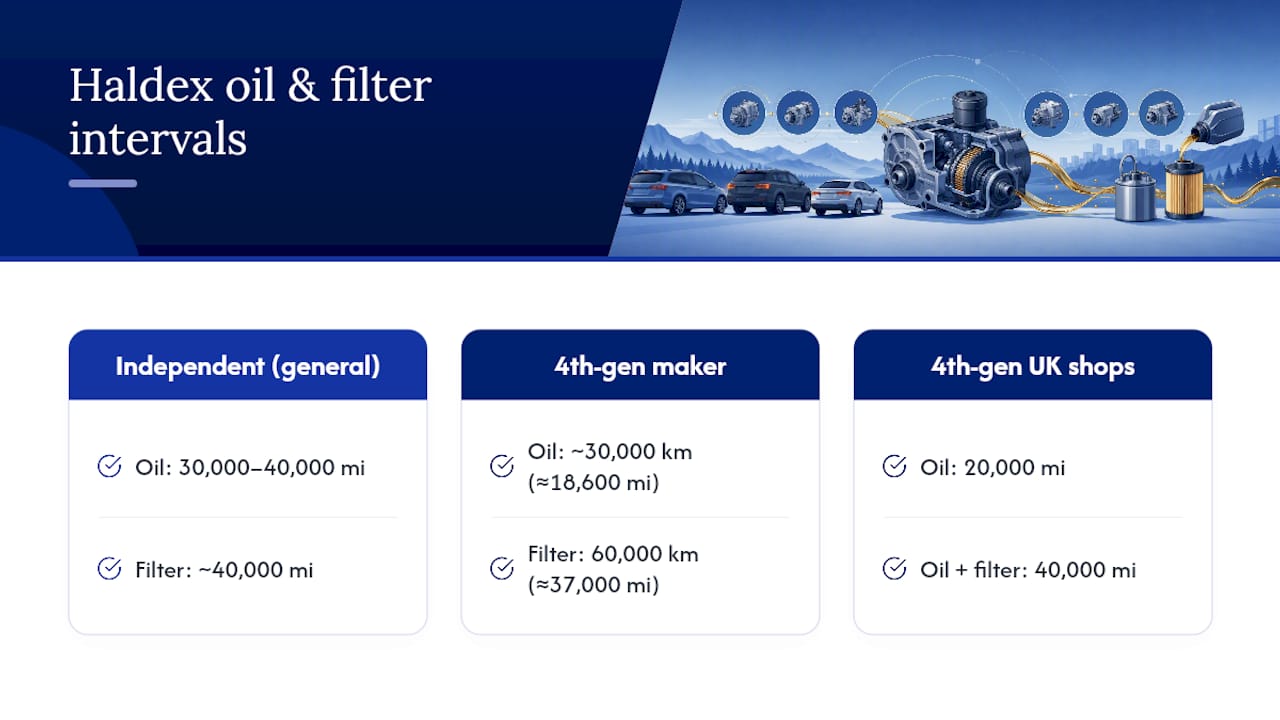
Here’s how that breaks down in practice.
If you tow, track your car, drive off road regularly, or rack up mostly short trips in stop-start traffic, shorten every one of these intervals. Heat cycling and contamination both accelerate faster under those conditions, and the coupling never gets a chance to run at a stable temperature long enough to keep debris in suspension rather than settling in the pump screen. Keep a simple log with date and odometer reading each time you service the unit. It costs nothing and it’s the first thing a workshop asks for if something goes wrong later.
What happens if you skip a Haldex service?
Ignore the interval for long enough and the symptoms tend to show up in a predictable order: an AWD warning light first, then a whining or straining noise from the pump under load, then patchy traction on loose surfaces or in the wet, and eventually clutch slip or a delay before the rear axle engages at all.
The mechanical cause is straightforward. Sludge and worn clutch material accumulate in the fluid over time, and that debris clogs the pump screen and the precharge oil passages that feed the multi-plate clutch. LIQUI MOLY’s technical documentation on Haldex units flags this contamination as one of the main causes of precharge pump failure, because a partially blocked pump has to work harder to build the pressure the clutch needs, and that extra load shortens its life.
What that means for your wallet:
- Diagnostics alone typically run £80 to £150 at an independent workshop.
- A rebuilt or reconditioned pump replacement often sits somewhere in the £300 to £600 range, parts and labour combined.
- A full service (oil, filter, screen clean) usually costs a fraction of that, which is the entire argument for staying ahead of the interval rather than reacting to it.
How do you service the Haldex oil and filter yourself?
A Haldex service is well within reach for anyone comfortable draining a gearbox or replace car air filter on a conventional car. It just rewards patience over speed, particularly around the pump screen.
What you’ll need: a torque wrench, new crush washers, a replacement filter (where your generation uses one), the correct Haldex oil, a drain pan, PPE (gloves and eye protection), and an OBD scanner to check for stored fault codes before and after.
- Scan for existing fault codes first, so you know what you’re dealing with before you start.
- Support the vehicle safely and locate the fill and drain plugs on the Haldex unit, following your drain plug removal guide if you’re unsure of the exact location.
- Drain the old oil and check its colour and consistency. Clear amber is fine; dark, gritty, or metallic-flecked fluid means the pump screen almost certainly needs attention too.
- Remove the precharge pump and clean the screen and housing thoroughly. LIQUI MOLY’s own guidance notes that heavier deposits often continue flowing later in the drain, so keep flushing until it runs clear rather than stopping at the first pass.
- Replace the filter if your generation uses one, along with new crush washers and lubricated O-rings on every seal you disturb.
- Refill through the fill hole until oil begins to drip out, which is the standard method for confirming correct fill level on most Haldex units, rather than relying on a fixed volume figure.
- Clear the fault codes, road test, and recheck for leaks and any warning lights after a few miles.
Pro Tip: If the filter won’t budge and you’re forcing it, stop. A filter that’s seized in its housing usually means corrosion or over-tightening from a previous service, and forcing it risks cracking the housing itself. Our guide to freeing a stuck Haldex filter covers safe methods before you reach for a bigger wrench.
Dispose of used oil and any contaminated cleaning fluid at a registered recycling point. Never tip it down a drain.
Which oil and parts actually fit your Haldex system?
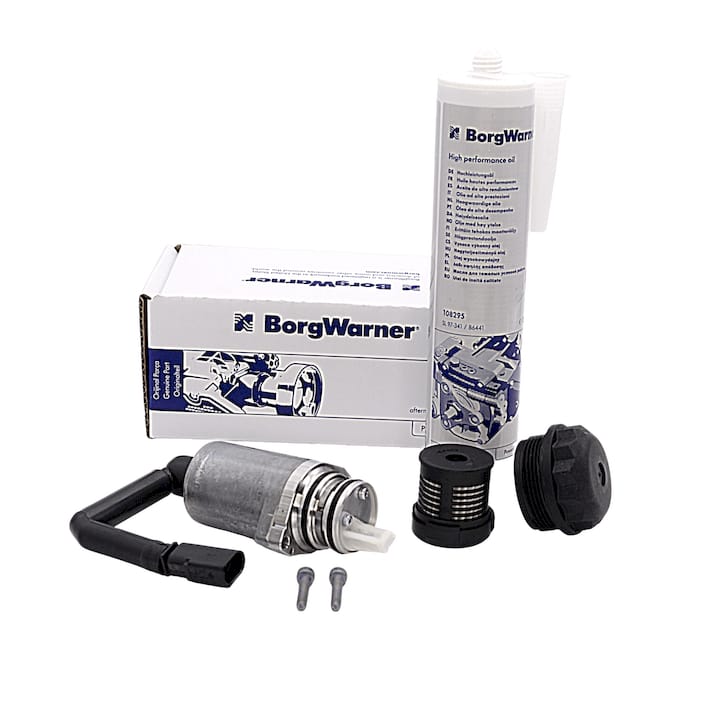
Getting the fluid spec wrong is one of the quickest ways to undo an otherwise careful service. Haldex clutches rely on specific frictional properties in the oil to engage smoothly, and independent guidance is consistent that using the wrong oil affects clutch feel and shortens component life. Stick to G055175A2 or a directly compatible BorgWarner multi-disc fluid, and don’t substitute a generic gear oil because it happens to be in the garage.
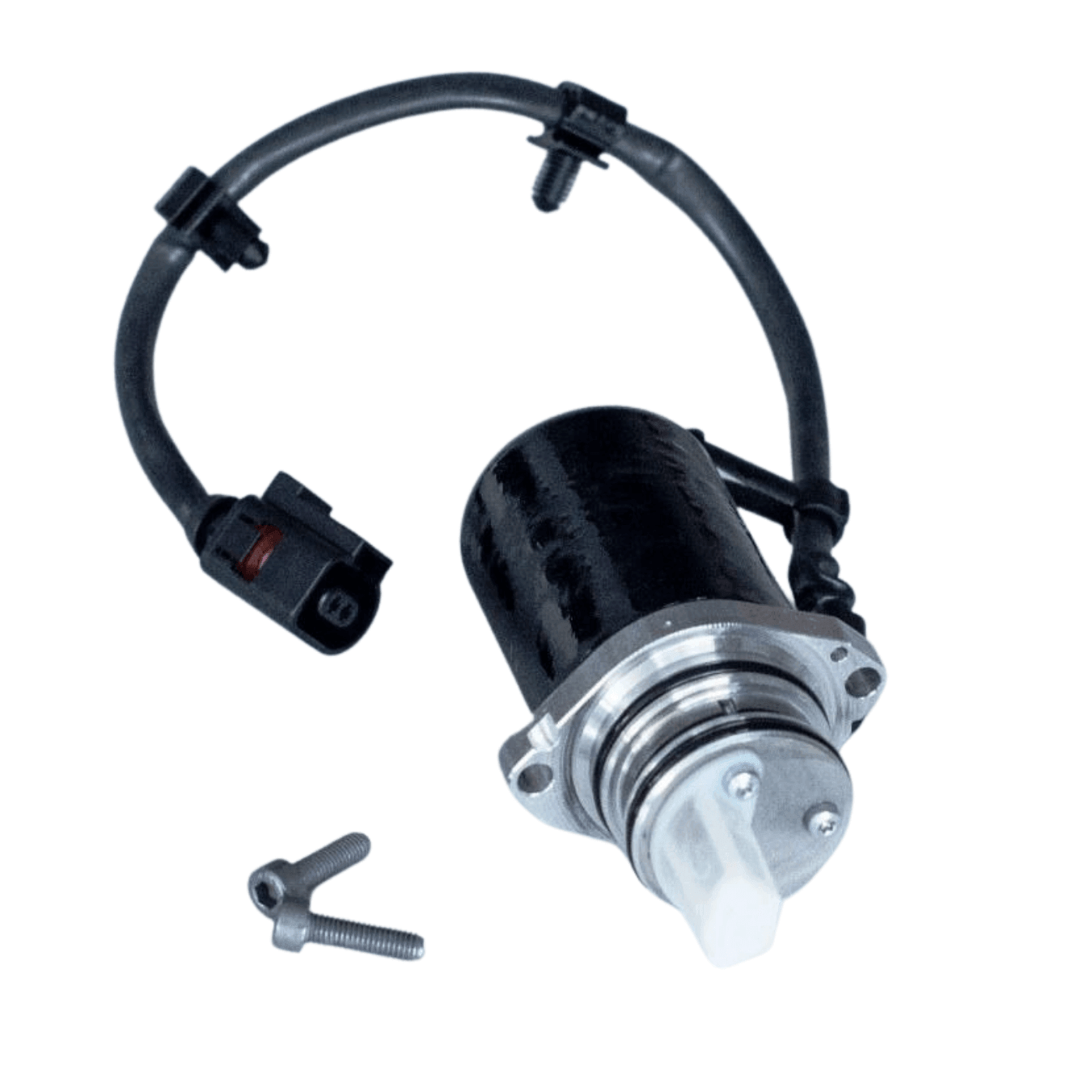
Filter availability varies by generation. First-generation units, like those covered by the 02D525557 precharge oil pump for early Audi TT and R32 fitments, often rely on screen cleaning rather than a separate filter. Fourth-generation units, by contrast, commonly use the 111358 filter alongside a matched pump and oil kit. Fifth-generation performance applications, including Porsche and Audi R8 fitments, use dedicated pumps such as the 9P1906271 and 0D4906271A, often paired with a seal repair kit and G055175A2 oil.
- Second-generation VAG platforms typically pair a pump, filter, and oil in one kit rather than sourcing each part separately.
- Volvo AWD models (S60, S80, V60, V70, XC70, XC60, XC90) use a distinct BorgWarner AOC filter assembly, not the VAG-pattern filters.
- SAAB, Opel, Vauxhall, Buick, and Cadillac AWD systems share their own coupling filter design entirely separate from both.
How does HaldexParts make DIY servicing easier?
Sourcing the wrong part for your generation is the single most common way a straightforward DIY service turns expensive. HaldexParts.co.uk stocks OEM-grade pumps, filters, and matched oil kits sorted by brand and generation, so you’re not guessing whether a part fits before it arrives.
- Model-fit guidance removes the trial-and-error of matching a filter to a specific pump generation.
- Practical resources, including the drain plug removal guide and notes on the 2003085 filter kit, back up the parts with real installation detail.
- Matched kits pair the correct crush washers and O-rings with the pump and filter, so torque specs and seals aren’t left to chance.
A technician’s honest rule of thumb
Inspect the Haldex unit at every service, change the oil at 20,000 to 40,000 miles depending on generation and use, and replace the filter around 40,000 miles where fitted. If the drain shows heavy sludge or the pump won’t come free cleanly, hand it to a professional rather than pushing on.
— Mindaugas
Get the right Haldex parts for your service
Haldexparts is the alternative to guessing your way through a parts catalogue: every kit is matched to a specific generation and fitment, so you order the pump, filter, and oil that actually belong together instead of piecing it together from three different listings and hoping. That matters most on a Haldex job, where the wrong filter or an incompatible oil spec is exactly what turns a two-hour service into a comeback repair.
Whether you’re servicing a Gen 2 VAG platform, a Volvo AOC filter assembly, or a fifth-generation Audi R8 pump, the Haldex service kits collection groups the right pump, filter, and oil together by fitment. If you’re only replacing one component, the filters, pumps, and oils collections are sorted the same way. Find your generation, check the fitment notes on the product page, and order the kit rather than the individual parts if you’re doing a full service in one go.
Sources
- DIY Haldex Service: A Comprehensive Guide | Willand Service Centre
- Technical information Haldex clutch (LIQUI MOLY)
- Servicing interval and step-by-step for GEN4 Haldex
- 4th-Generation Haldex - Oil Change. When Should You Change the Oil in the Haldex System?