

Check fluid condition and pump-screen restriction, read and log fault codes before clearing anything, and enforce a risk-based service interval instead of a calendar-based one. Those three actions prevent most fleet Haldex failures long before they become roadside breakdowns or warranty disputes. Most units that fail in service were showing signs for weeks: darkening oil, an intermittent stability warning, a connector nobody re-seated after the last wash.
Start today with three checks on any vehicle you’re worried about:
- Pull a fluid sample and check colour and particulate content against a known good reference.
- Inspect the pump pickup screen for restriction if the vehicle has logged any AWD warning in the last month.
- Run a fault-code scan and record everything before you clear a single code.
The inspection checklist and diagnostics sections below turn these three checks into a repeatable routine your technicians can run without guesswork.
Key Takeaways
The most effective fleet Haldex failure prevention strategy combines fluid and screen inspection, disciplined fault-code logging, telemetry-triggered service intervals, and stocked OEM-grade kits matched to each unit’s generation.
| Point | Details |
|---|---|
| Grade fluid at every service | Use a three-stage scale (good, contaminated, replace) to remove ambiguity from sampling decisions. |
| Log codes before clearing | Record full fault history and confirm root cause fixed before wiping any code. |
| Segment by duty cycle | Heavy-duty, towing and coastal/winter routes need shorter service intervals than light urban use. |
| Watch pump current, not just pressure | Rising current under load can flag a starving pump before pressure traces show a drop. |
| Use telemetry to trigger service | Feed reservoir pressure trends and stability event frequency from tools like Fleet+ directly into work orders. |
| Stock generation-matched kits | Haldexparts’s OEM-grade pump-nose, seal, and pump-and-oil kits cover first through fifth-generation units for planned replacement. |
Table of Contents
- How to build a fleet Haldex failure prevention strategy
- What should drivers and technicians check on inspection?
- What tests confirm a Haldex fault’s root cause?
- When should you tighten your Haldex service intervals?
- Should you repair the unit or replace it outright?
- Which fault codes signal a Haldex failure before it happens
- Why contaminated Haldex fluid causes most failures
- How electrical faults get mistaken for mechanical failure
- How to handle an unexpected Haldex failure on the road
- What training do technicians and drivers actually need?
- Does preventive maintenance actually save fleets money?
- How to fold manufacturer updates and recalls into your schedule
- What fleet managers get wrong about Haldex prevention
- Get the right Haldex parts before the next failure, not after
- Sources
How to build a fleet Haldex failure prevention strategy
A prevention strategy only works if it assigns clear ownership and gives everyone a rule to act on, not a vague instruction to “keep an eye on it.” Segment vehicles by duty cycle first: heavy-haul and off-highway units see far more contamination and thermal stress than depot delivery vans doing gentle mileage on tarmac. Environment matters as much as mileage. A gritter running winter routes accumulates road salt and moisture ingress at a rate that would take a motorway courier three times as long to match.
Set three decision rules and write them down so nobody has to improvise at 6am:
- Service now — fluid graded contaminated, any active fault code, or pump current spikes on an induced engagement.
- Monitor — fluid borderline, no active codes, but the vehicle sits in a high-risk segment (heavy duty cycle, coastal or winter operation, high mileage since last service).
- Replace — repeat failures after two service interventions, or physical wear evident on pump or clutch pack inspection.
Ownership splits naturally along these lines: drivers run the daily visual and warning-light check, technicians run the triage and diagnostic capture, and the fleet manager owns the go/no-go call on service versus replace, informed by the telemetry data covered further down.
Pro Tip: Give your triage technician authority to hold a vehicle out of service on a “monitor” flag without needing fleet manager sign-off first — the delay between flag and action is where most preventable failures turn into roadside recoveries.
What should drivers and technicians check on inspection?
Daily driver checks and scheduled technician inspections catch different things, and conflating them is a common mistake. Drivers spot warning lights and obvious leaks; only a technician with the vehicle raised will catch a corroding connector or a screen starting to clog.
On visual inspection, look for:
- Fluid seepage around the pump housing, hose fittings and the rear differential coupling.
- Wiring corrosion or chafing near the pump connector, especially on vehicles that run gritted or coastal routes.
- Connector seating: a connector that looks plugged in but isn’t fully latched will produce intermittent faults that never show up on a static bench check.
- Reservoir cap and breather condition, since a blocked breather can produce pressure anomalies that mimic pump failure.
Fluid assessment goes beyond a glance. Clean Haldex fluid runs light amber; contaminated fluid darkens and carries visible particulates. A practical fleet rule worth adopting is a simple three-stage grading at every scheduled PM: good, contaminated, or replace, which removes the ambiguity that lets a “probably fine” sample slide for another 10,000 miles, a rule reflected in Haldex’s own trailer systems troubleshooting guidance. Pump screen and reservoir pressure checks should happen at every scheduled service, not just when a warning appears, because independent technical reviews note that blocked pickup screens are one of the most common recurring root causes of Haldex faults that get missed until the unit is already struggling.
Log every finding against a pass/fail standard, not a subjective note. “Fluid amber, no particulates, screen clear” passes; “fluid slightly dark” should trigger a mandatory sample rather than a technician’s judgement call.
What tests confirm a Haldex fault’s root cause?
Fault codes tell you where to look, not necessarily what’s wrong, and treating a code as a diagnosis rather than a starting point wastes parts and labour. Electrical faults, contamination and mechanical wear can all trigger overlapping codes, so a structured test sequence matters more than the code itself.
- Pull and record the full fault history before touching anything. Manufacturer service guidance is explicit that fault codes should only be cleared once the underlying cause is confirmed and fixed, because clearing early erases the only record of an intermittent problem.
- Capture live data during an induced engagement: oil pressure trace, pump current draw and engagement timing. A pump with a partially blocked pickup screen often shows rising current under load before the pressure trace drops, which means logging current can flag a starving pump earlier than pressure data alone would.
- Run a scripted road test that includes a low-traction manoeuvre (a gravel yard, a wet roundabout) to confirm the system actually engages when commanded, not just when static-tested.
- Bench test the pump for pickup and pressure behaviour if the road test and live data disagree, isolating whether the fault sits in the pump, the wiring, or the control logic.
Results that show a clean pressure trace with an isolated wiring fault point to repair. Results showing consistent pressure loss under load, confirmed on the bench, point to replacement. Structured troubleshooting manuals pair each common complaint with a specific remedy for exactly this reason: guesswork between repair and replace is where fleets lose money on both sides of the decision.
Pro Tip: Never clear a code the same day you find it. Run the vehicle through at least one full duty cycle first and confirm the fault doesn’t return before wiping the history.
When should you tighten your Haldex service intervals?
Baseline intervals depend on how hard the vehicle actually works, not the number on the odometer alone. Light-duty vans on predictable urban routes can generally run to the standard manufacturer interval. Medium-duty regional trucks with mixed terrain need a modest pull-forward, typically a service check at the midpoint of the standard interval. Heavy-duty and off-highway units, especially anything towing regularly or running in salt, mud or extreme temperature swings, should be inspected on a materially shorter cycle regardless of what the calendar says.
Several signals should shorten the interval automatically rather than waiting for the next scheduled date:
- Any contamination incident logged at a previous service.
- Repeated stability-control events flagged by the vehicle’s own systems.
- Sustained towing or heavy-load operation outside the vehicle’s normal profile.
- A pump that showed borderline current draw on its last live-data capture.
| Operational profile | Baseline PM interval trigger | Shorten if |
|---|---|---|
| Light duty (urban, low load) | Standard manufacturer interval | Any active fault code appears |
| Medium duty (regional, mixed terrain) | Midpoint check added between standard intervals | Contamination graded at last service |
| Heavy duty (towing, off-highway, coastal) | Shortened fixed interval, inspected every cycle | Repeated stability events or high axle load readings |
Fleet telemetry closes the gap between a fixed calendar and real operating conditions. Haldex Fleet+ tracks reservoir pressure trends, stability events, axle load and mileage across a trailer fleet, and a rising frequency of low-pressure events or repeated stability interventions is a strong early-warning signal worth acting on before the next scheduled service, not after. Feed these alerts directly into your workboard so a telemetry flag opens a work order automatically rather than sitting in a report nobody reads until month-end. Haldexparts’s own fleet maintenance guide walks through building that workflow around a real service calendar.
Should you repair the unit or replace it outright?
Cleaning and fluid replacement genuinely restore function in a large share of cases, particularly where the pump itself isn’t worn and the fault traces back to contamination or a blocked screen. Field reports consistently show that early servicing resolves many Haldex complaints without full unit replacement, provided the fault is caught before repeated cycles have worn the pump or clutch pack. Once you see scoring on pump internals, clutch pack slippage under load, or a unit that’s already had two service interventions for the same symptom, replacement is the more reliable route.
Stock these as standard fleet spares, scaled to your vehicle count rather than bought reactively:
- Pump-nose service parts for older-generation units, following the pump-nose replacement guidance for first and second-generation Haldex pumps.
- A fourth-generation repair seal kit, such as the BorgWarner seal kit covering Volvo, Land Rover, Ford, VW and Audi applications.
- A complete pump-and-oil kit for fifth-generation applications, including the Jaguar F-Pace service kit.
Pro Tip: Stock at least one complete kit per ten applicable vehicles in your fleet, not per model, so a failure on any unit of that generation doesn’t leave a truck grounded waiting on a part.
Which fault codes signal a Haldex failure before it happens
Most Haldex failures announce themselves days or weeks before they strand a vehicle, if anyone is watching the right signals. An intermittent AWD warning lamp that clears itself on restart is the classic early tell. So is a stability-control intervention on a corner the driver has taken hundreds of times without incident. Neither looks urgent in isolation. Together, logged over a fortnight, they’re a pattern.
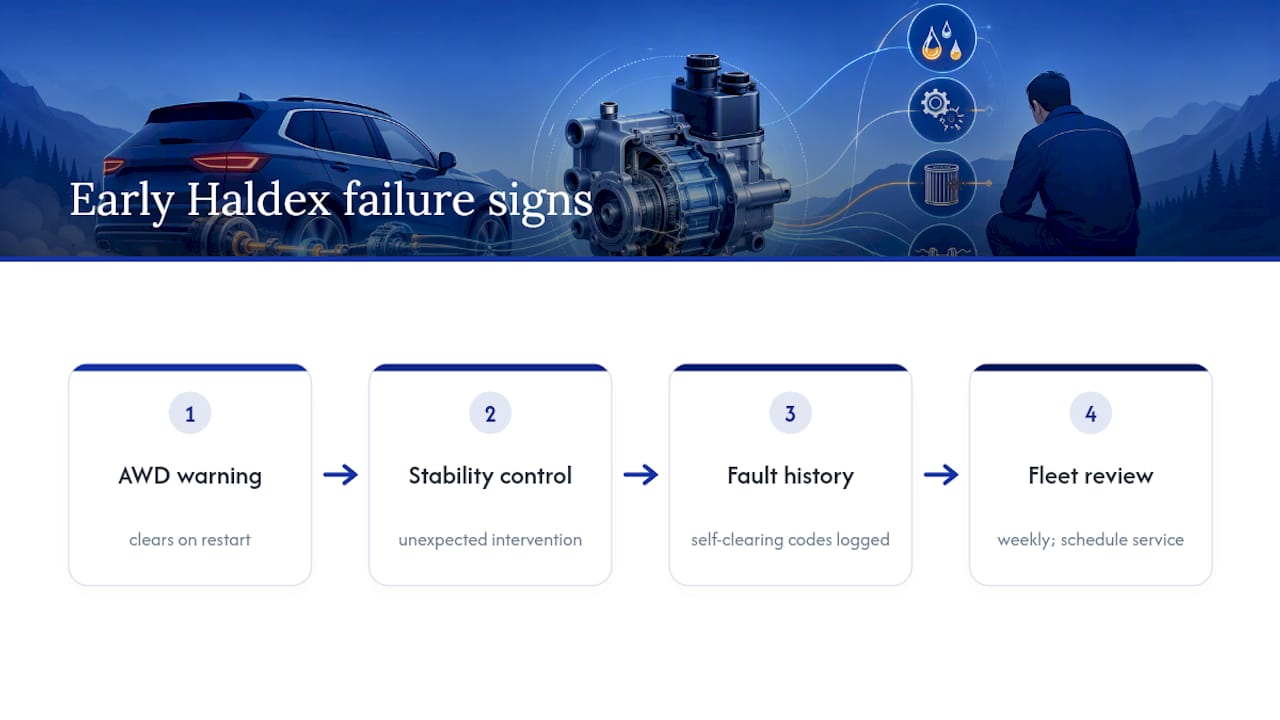
Fault code families worth flagging immediately rather than filing for the next service: pump pressure faults, which usually point to contamination or a restricted screen rather than pump failure itself; sensor or wiring circuit faults, which often mimic mechanical failure but resolve with a harness repair; and control module communication faults, which can indicate anything from a corroded connector to a software fault requiring a manufacturer update. The trailer systems troubleshooting guide is explicit that distinguishing a parking or emergency brake fault from a service brake fault is the first diagnostic branch, because treating one as the other wastes the diagnostic window entirely.
The mistake most fleets make is treating a self-clearing warning as a non-event. It isn’t. An intermittent code that clears on restart still logs in the fault history, and that history is the only evidence you have of a problem building towards failure. Reviewing fault history weekly across the fleet, rather than only when a driver reports a warning light, catches units heading toward failure while they’re still in the “service now” category rather than the roadside recovery category.
Why contaminated Haldex fluid causes most failures
Degraded fluid is behind more Haldex failures than worn mechanical parts, and it’s the easiest failure mode to prevent because it’s entirely visible if someone actually looks. Haldex fluid darkens and picks up particulates as it ages, and once contamination reaches a meaningful level it accelerates wear on the exact components that are expensive to replace: the pump internals and the clutch pack.
The pump pickup screen is the first casualty. It’s designed to catch debris before it reaches the pump, which means it’s also the first place restriction shows up, and a partially blocked screen starves the pump under load long before any dramatic symptom appears. That’s why a live-data capture showing rising pump current under load, ahead of any drop in pressure, is often the earliest warning available, a pattern documented in manufacturer troubleshooting guidance for exactly this fault mode.
Filter and screen checks belong at every scheduled service, not as an occasional deep-clean item. The fix is unglamorous and cheap relative to the alternative: sample fluid at every PM, grade it against the three-stage scale (good, contaminated, replace), and treat “contaminated” as a mandatory screen inspection, not an optional one.
How electrical faults get mistaken for mechanical failure
Wiring and connector faults produce symptoms that look identical to pump or clutch failure, which means a fleet that skips electrical checks ends up replacing good pumps. A corroded connector pin, a chafed harness rubbing against a chassis member, or a connector that’s seated but not fully latched can all produce the same intermittent AWD warning as a genuinely failing pump.
The distinguishing test is live-data behaviour under a controlled engagement. A mechanical fault, such as a worn clutch pack or a pump losing pickup, tends to show a consistent, repeatable pattern: pressure drops the same way every time under the same load. An electrical fault tends to be inconsistent, appearing on one engagement and not the next, especially if it’s connector-related and sensitive to vibration or temperature.
Manufacturer service documentation is specific about sensor and harness installation for exactly this reason: a badly routed harness or an improperly seated sensor connector generates fault codes that read as system failures to a driver, but are a five-minute fix for a technician who checks the physical connection first. Before condemning a pump or control module, physically inspect every connector in the circuit, check for corrosion at the pins, and flex the harness gently while monitoring live data to see if a fault appears under movement.
This is also where clearing codes too early does real damage. An intermittent electrical fault that gets cleared before the technician traces it will simply reappear on the next duty cycle, often after the vehicle has already been signed off as repaired. The fault history is the diagnostic trail. Erase it and you’re troubleshooting blind next time.
How to handle an unexpected Haldex failure on the road
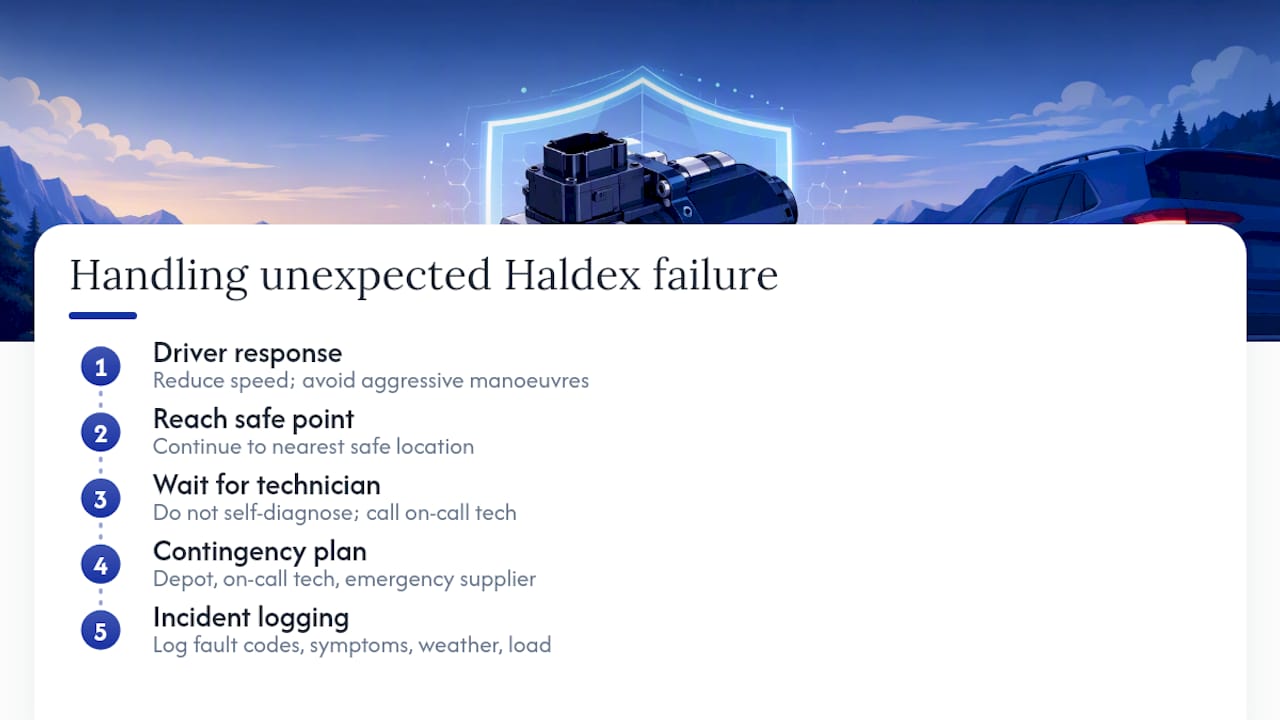
A Haldex failure in service is rarely a safety-critical brake failure outright. Most commercial vehicles retain a functioning primary braking system even if AWD engagement drops out entirely, but the loss of traction assistance changes vehicle behaviour enough that drivers need a clear protocol, not a guess.
The first step is driver instruction: if an AWD warning appears mid-route, the driver should reduce speed appropriate to conditions, avoid aggressive cornering or heavy load transfer manoeuvres, and continue to the nearest safe point rather than attempting self-diagnosis. Drivers are not technicians, and the guide to determining whether a fault sits in the parking/emergency system or the service brake system makes clear this distinction genuinely matters for safe handling decisions on the road, not just for the workshop.
Contingency planning means having a decision tree ready before the call comes in: which depot has a loaner or backup vehicle, which technician is on call for a road-side fault code read, and which supplier can turn around an emergency part order. A fleet that stocks its own service kits, rather than ordering reactively once a vehicle is already down, cuts recovery time from days to hours. That’s the practical argument for holding stock of the kits covered in the parts section above rather than treating them as order-on-demand items.
Log every roadside incident the same way you’d log a scheduled inspection finding: fault codes present, driver-reported symptoms, weather and load conditions at the time. That data feeds directly back into your risk segmentation, and a pattern of roadside failures on one route or one duty cycle is the clearest signal your interval is wrong for that vehicle segment.
What training do technicians and drivers actually need?
Most fleets under-train drivers and over-assume technician competence, and both gaps cost money. Drivers don’t need to diagnose Haldex faults, but they do need to recognise the difference between a warning that means “get this checked at the next service” and one that means “pull over now,” and most driver training programmes never make that distinction explicit.
Technician training should cover three things beyond general brake system knowledge: reading and interpreting Haldex-specific fault code families rather than treating all AWD codes as equivalent, running a live-data capture correctly (a pump current trace is worthless if the induced engagement wasn’t representative of real load), and understanding when a fault code history has been compromised by premature clearing. A technician who’s only ever worked on conventional hydraulic systems will often reach for a part swap where a Haldex specialist would reach for a fluid sample first.
Best practice, in practical terms, means:
- New technicians shadow a full diagnostic sequence, start to finish, before working unsupervised on a Haldex fault.
- Drivers receive a one-page reference (not a manual) covering the two or three warning states that require an immediate stop.
- Fault-code interpretation training is refreshed whenever a new generation of unit enters the fleet, since fourth and fifth-generation systems don’t always behave identically to earlier ones.
Haldexparts’s guide on recognising early failure signs is worth circulating to both audiences precisely because it separates driver-relevant symptoms from technician-relevant diagnostics rather than treating them as one document.
Does preventive maintenance actually save fleets money?
The honest answer is that preventive maintenance costs more upfront and less overall, and the gap widens the longer a fault goes unaddressed. A fluid change and screen clean caught early costs a fraction of a pump replacement, and a pump replacement caught early costs a fraction of a roadside recovery plus a missed delivery window plus a driver sitting idle.
The comparison that actually matters for a fleet manager building a budget case isn’t parts cost versus parts cost. It’s parts cost versus total cost of failure, which includes recovery, downtime, missed service level agreements, and in some cases the knock-on effect of an unplanned inspection revealing a second vehicle with the same undiagnosed issue. Understanding why Haldex components degrade over time reframes the maintenance spend as risk reduction rather than a cost centre, which is the argument that tends to land better with finance teams than a straight parts-price comparison.
Reactive repair also carries a hidden tax: emergency parts sourcing. A fleet that orders a repair kit only after a vehicle is down pays for both the part and the delay, whereas a fleet that stocks kits against its own risk segmentation absorbs the part cost on a predictable schedule instead. This is where planning PM schedules across a multi-vehicle fleet pays off in a way that’s hard to see vehicle by vehicle but obvious across a full year of fleet accounts: fewer emergency orders, fewer expedited shipping charges, fewer vehicles sitting idle waiting on a part that should have been on the shelf.
How to fold manufacturer updates and recalls into your schedule
A prevention strategy that ignores manufacturer bulletins is working with incomplete information, because some Haldex fault patterns trace back to a known issue with a fix already published, not a maintenance gap. Software or control-logic updates for control module communication faults are a common example: a fault that looks like a wiring problem on the bench can sometimes be a known firmware issue with a documented update.
Build a standing check into your maintenance workflow rather than relying on someone remembering to look. Assign one person, not a rotating duty, to review manufacturer service bulletins on a fixed monthly cadence and cross-reference them against your fleet’s vehicle identification numbers and Haldex generation. When a bulletin applies, treat it the same as a “service now” flag rather than folding it into the next routine service, since bulletins are usually issued because a known fault pattern is already causing failures elsewhere in the field.
Recalls need a harder rule: any open recall against a Haldex component grounds that vehicle from the affected duty (particularly towing or high-load work) until the recall action is completed, regardless of how the vehicle is currently performing. Waiting for a symptom to appear defeats the purpose of a recall notice, which exists precisely because the fault pattern isn’t always visible before it fails.
Keep a simple log linking each vehicle’s identification number to its Haldex generation, last bulletin review date, and any open recall status. That log becomes the single reference your triage technician checks before signing off any “monitor” decision, closing the loop between the decision rules set out earlier and the manufacturer’s own field data.
What fleet managers get wrong about Haldex prevention
The conventional advice on Haldex maintenance treats it as a scheduling problem: hit the interval, change the fluid, move on. That’s not wrong, exactly, but it misses where the real risk sits. The fleets that actually avoid failures are the ones that treat fault-code history as diagnostic evidence rather than an inconvenience to clear, and that watch pump current under load rather than waiting for pressure to drop.
What’s overrated is the fixed calendar interval on its own. A vehicle running gentle urban routes and one running gritted winter roads shouldn’t share a service date just because they left the depot the same week. What’s underrated is the discipline of never clearing a code before the cause is confirmed. Fleets lose that diagnostic trail constantly, usually because clearing the warning feels like solving the problem.
If you do one thing differently after reading this, make it the fluid and screen check at every service, paired with a telemetry review that actually feeds into your work orders rather than sitting in a report. That combination, backed by a stock of the right generation-matched parts, catches almost everything else this article covers before it becomes a roadside call.
— Mindaugas
Get the right Haldex parts before the next failure, not after
Haldexparts exists because most fleets don’t discover they need a pump seal kit until a vehicle is already off the road, and sourcing OEM-grade parts under pressure costs more in both time and money than stocking them in advance. Every kit on the site is matched by brand and Haldex generation, so you’re not guessing whether a part fits an Audi fourth-generation unit versus a Jaguar fifth-generation system.
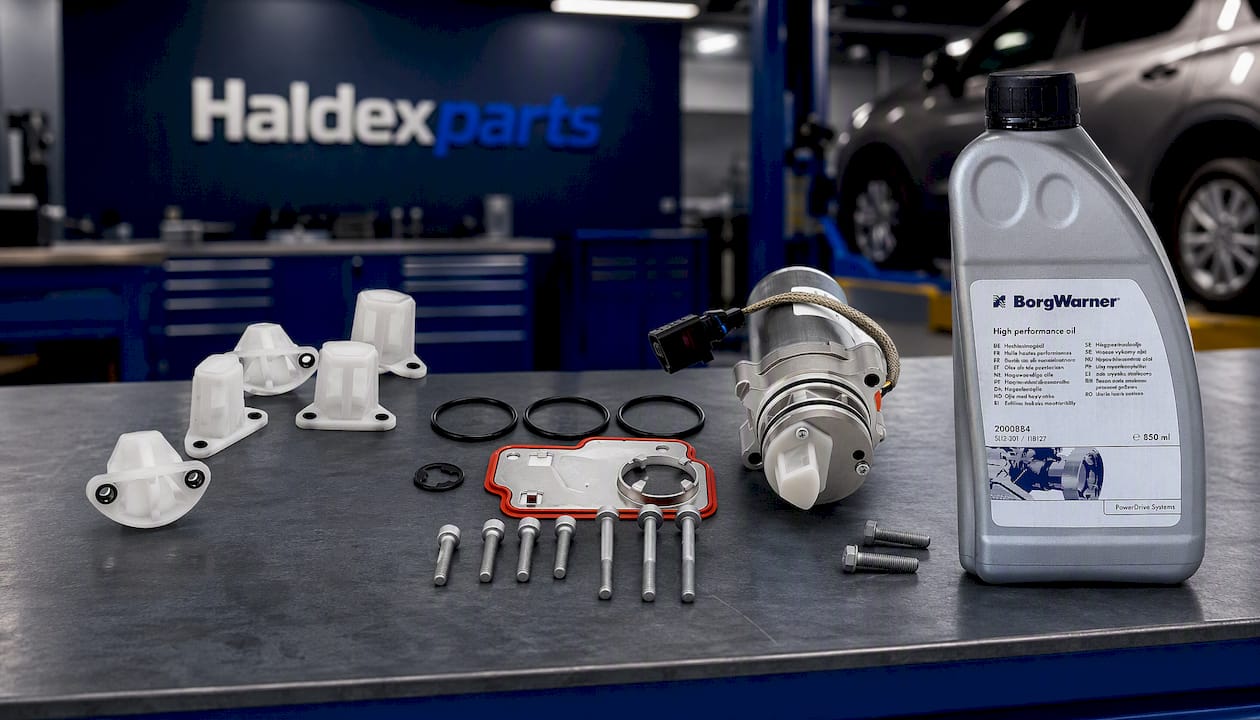
That generation-matching matters more than it sounds. The BorgWarner repair seal kit for fourth-generation units covers Volvo, Land Rover, Ford, VW and Audi applications from a single product line, and the complete pump and oil kit for the Jaguar F-Pace’s fifth-generation system gives you both halves of the service in one order rather than chasing separate suppliers for pump and fluid. For fleets still running earlier units, the pump-nose service parts for first and second-generation pumps cover a repair path a full pump replacement often isn’t necessary for.
Orders over £150 ship free, which makes stocking a full set of generation-matched kits across your fleet’s vehicle mix a straightforward budget line rather than a series of small, expensive orders. Check your fleet’s Haldex generations against the product pages now and place your stock order before the next fault code, not after it.
Sources
- Fleet+ : trailer data management
- Haldex troubleshooting guide (technical PDF)
- Trailer systems troubleshooting guide (Haldex L20305)
- Haldex service signs explained clearly - Mechalex
- Haldex installation and service guide (L30041)