

A Haldex fuse that blows more than once almost always means an active short to ground or a Haldex pump motor drawing far more current than the circuit can handle, not a faulty fuse. Stop fitting new fuses. Unplug the Haldex pump or DEM harness connector and leave the circuit unpowered until you’ve isolated the fault. Never fit a higher-rated fuse or bypass the circuit to get the AWD warning light off. That single move turns a £3 fuse into a potential wiring fire.
TL;DR:
- Repeated fuse blows usually indicate an active short to ground or a pump motor drawing excessive current, not a faulty fuse.
- Instant fuse failure on power-up signals a short in wiring or connectors, while delayed blows point to the pump motor itself.
- Visual inspection, correct fuse rating, and unplugging the pump or DEM connector are essential first steps before replacing components.
- Common causes include the pump motor, wiring chafe points, corroded connectors, or faulty sensors and solenoids inside the pump assembly.
- Never use a higher-rated fuse or bypass the circuit, as this risks wiring fires and undermines the circuit’s safety protections.
Table of Contents
- Haldex fuse issues: what usually causes them, ranked
- Troubleshooting Haldex fuse faults: step-by-step tests
- Which Haldex parts actually cause a fuse to blow
- Haldex fuse location and correct amperage by generation
- Fixing a blown Haldex fuse: repair paths, costs and DIY limits
- A practical, prioritised workflow for a blowing Haldex fuse
- Sourcing the right Haldex pump for your repair
- Sources
- FAQ
Haldex fuse issues: what usually causes them, ranked
Not every fuse-blow points to the same fault, but the timing tells you almost everything before you pick up a tool. Blown fuse diagnosis follows a simple rule: something downstream is pulling more current than the fuse can pass, and a repeated blow means that overload is still there, not that you got a dud fuse.
Run through these in order, because each pattern narrows down the search fast:
- Fuse blows the instant you switch on — this is almost always an active short to ground, often a chafed wire touching the bodywork or a pin that’s worked loose and is grounding against the connector housing.
- Fuse survives a few seconds or minutes, then blows — that delay usually points to the pump motor itself, either seizing internally or drawing excess current as bearings or the armature wear.
- Fuse blows intermittently, sometimes fine for days — corroded connector pins, water ingress into the DEM area, or a wiring route that only makes contact when the suspension flexes.
- Fuse blows only after other work — check whether an added accessory now shares the same feed, whether the wrong-rated fuse got fitted by mistake, or whether alternator voltage spikes are stressing the circuit.
Real-world reports from Volvo owners repeatedly point to the AOC/Haldex oil pump developing a short to ground and taking out the rear electronic module’s 7.5A fuse, a pattern seen often enough on older platforms that it’s usually the first component worth suspecting. A blown fuse that repeats the moment you replace it is typically an active short, while one that holds briefly before failing again suggests a component drawing extra current rather than a dead short. That distinction alone should decide which test you run first.
Troubleshooting Haldex fuse faults: step-by-step tests
Diagnosis works best as a funnel: broad checks first, then narrower isolation, then a bench test that gives you a definitive answer. Skipping steps is how people end up swapping a £200 pump when the actual fault was a £15 connector.
- Confirm the correct fuse rating first. Check the fusebox lid or the owner’s manual before touching anything else. Fitting the wrong amperage fuse can mask a smaller fault or blow prematurely under normal load.
- Do a visual and smell check. Pull the blown fuse and look at the fusebox for melted plastic, look at the element inside the fuse (a fuse that’s blackened rather than simply snapped suggests a hard short), and sniff for burnt insulation near the harness routing.
- Reinstall a fuse and note how fast it fails. Instant failure on power-up means an active short somewhere in the loom or connector. A fuse that survives the ignition cycle but fails once the pump tries to run points at the motor.
- Unplug the Haldex pump or DEM harness connector, then fit a fresh fuse. If the fuse now holds, the fault sits in the pump or its immediate wiring. If it still blows with the connector disconnected, the short is upstream in the harness or in the DEM itself.
- Bench test the pump with a fused 12V supply and an ammeter. Applying a fused test lead to the pump and measuring current draw is the only reliable way to confirm motor health before you reinstall it. A healthy pump typically draws a modest, steady current and spins freely; a pump that pulls high current, stalls, or won’t spin at all has failed internally.
- Wiggle-test the harness under load. Flex the loom near the rear wheel arch and under the rear seats, common chafe points, while watching for the fault to reappear. Probe suspect sections for continuity to ground with a multimeter.
- Read the fault codes with a scan tool. On fifth-generation Haldex systems, a weak power supply to the controller can trigger code 16671, which points at the fuse or a damaged connector rather than the pump motor itself. Don’t assume a pump fault code always means the pump; on Gen‑5 systems in particular, check both 12V feeds before ordering parts.
Pro Tip: Always disconnect the battery before probing connectors with a test light, and use a fused jumper lead rather than a bare wire when bench testing a pump. A dead short across an unfused 12V feed can weld a multimeter probe to a terminal in seconds.
Which Haldex parts actually cause a fuse to blow
Four components account for most repeat fuse failures, and each one leaves a slightly different signature.
- The oil pump motor itself. A pump nearing the end of its life often hums under load rather than spinning cleanly, and a seized or partially seized motor shows up on a clamp meter as a current spike well above its normal draw the moment it’s asked to run.
- The DEM (Haldex electronic module). Weak feeds are a known issue on fifth-generation systems with dual 12V power feeds, and corrosion inside the module’s connector housing can create an intermittent short that only shows up when the car’s been sitting in wet weather.
- Wiring and connectors. The most common chafe points are the rear wheel arch liner and the harness run under the rear seats, where a damaged connector is a recurring fault point on several VAG and Volvo platforms. Water tracking down this run and pooling at a low connector is a classic cause of an intermittent, weather-dependent blow.
- Sensors and solenoids. A shorted pressure sensor or solenoid inside the pump assembly can overload the same fuse the pump uses, so a fault that looks like a pump failure sometimes turns out to be a £20 sensor.
- Grounds and shared circuits. A poor chassis ground forces more current through whatever path is available, and a fuse shared with an aftermarket accessory can blow under the combined load even when neither component is faulty on its own.
Haldex fuse location and correct amperage by generation
Getting the fuse right matters as much as diagnosing the fault, because fitting the wrong rating either fails to protect the circuit or blows for reasons that have nothing to do with the Haldex system.
Fuse position varies by generation and by model. Older Haldex-equipped platforms commonly route the pump feed through a small mini fuse in the main interior fusebox, often rated around 7.5A, while fifth-generation systems can use dual 12V feeds across two separate fuse positions, meaning a single blown fuse doesn’t always tell the whole story. Some models locate a secondary fuse in the engine bay box rather than the cabin.
- Check your owner’s manual or the fusebox lid diagram before assuming a rating.
- Photograph the fusebox layout and the fuse itself before removing it, so you have a reference if the label wears off.
- Keep an OEM-spec spare fuse in the car rather than relying on whatever’s closest in the assortment pack.
- If your model isn’t obvious from the lid diagram, Haldexparts’ fuse location finder guide covers model-specific positions in more detail.
Fixing a blown Haldex fuse: repair paths, costs and DIY limits
Once you know where the fault sits, the repair falls into one of three brackets: a cheap wiring or connector fix, a pump replacement, or a DEM replacement that usually needs dealer-level coding.
- Connector and wiring repairs. Cleaning corroded pins, repairing a chafed section of loom, or resealing a connector against water ingress are all realistic DIY jobs, and parts cost is usually minor compared to labour at a shop.
- Pump replacement. If the bench test showed high current draw, a stall, or no spin at all, the pump needs replacing rather than repairing. This is where matching the right part number to your generation matters, since fitting the wrong pump variant won’t solve the fault and may not fit the housing correctly.
- DEM/module replacement. If there’s no voltage reaching the pump with the ignition on and the harness has already tested clean, the module itself may be the failure point, though this often needs a dealer-level tool such as VIDA or VAS to code the new unit to the car. Verify voltage is actually missing before ordering a module. Codes pointing to weak power supply don’t automatically mean the pump has failed.
- Diagnosis before parts. A scan tool session costs far less than an unnecessary pump or module, and reading the fault code first, especially the Gen‑5 power-feed codes covered in Haldexparts’ fault code guide, can save an expensive guess.
- Rough cost and time expectations. A connector clean-up or wiring repair is typically a half-day DIY job with modest parts cost. Pump replacement runs longer, particularly on models where the pump sits behind the rear differential and needs the exhaust or heat shield moved. DEM replacement takes the longest once coding time is factored in, and is generally better handled by an independent workshop or dealer with the right diagnostic interface.
Pro Tip: Document every test result, the fuse rating, the current draw figure, and which connector you unplugged, before you order parts. If you end up at a workshop, that record saves them a full re-diagnosis and usually saves you labour hours.
Never fit a higher-rated fuse to “get past” a repeat blow, and never bypass the fuse entirely. Doing either removes the circuit’s only protection and risks overheating the harness well beyond the point a fuse would have stopped it.
A practical, prioritised workflow for a blowing Haldex fuse
The order matters more than the individual steps. Inspect first, confirm the fuse rating, isolate the harness, bench test the pump, read the codes, then repair or replace, in that sequence, because doing it out of order is how good parts get condemned for someone else’s fault.
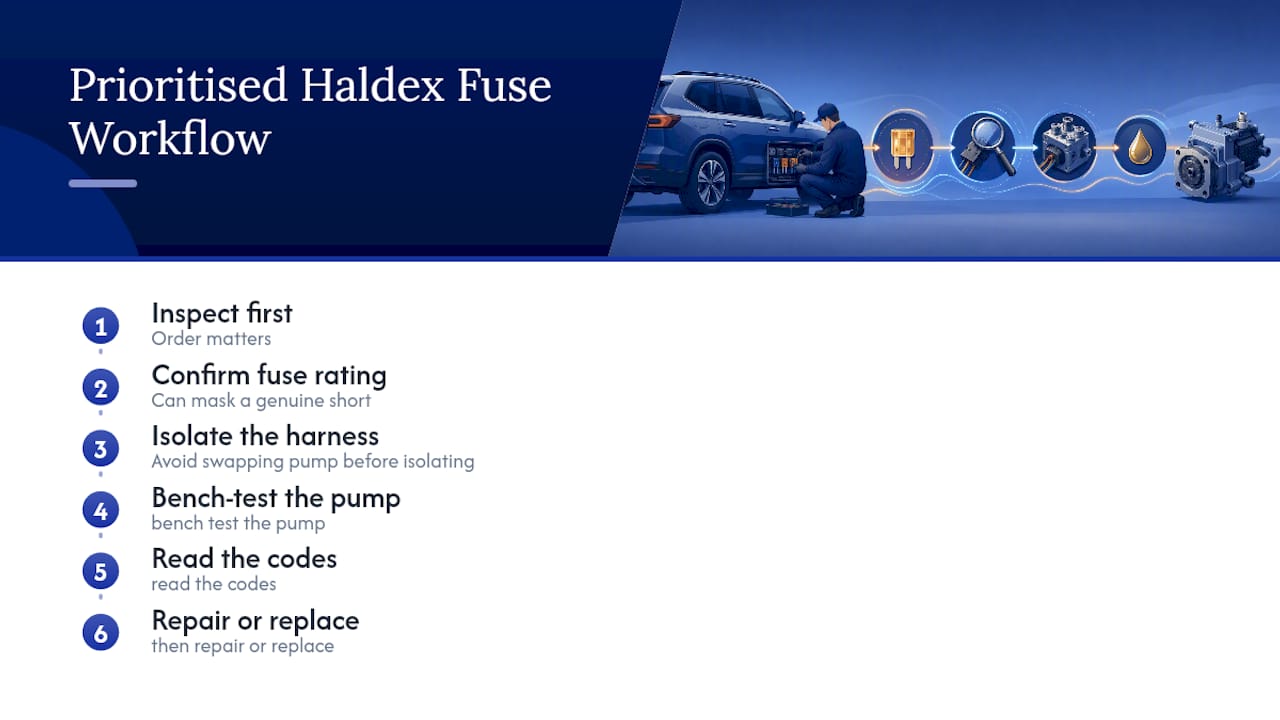
The mistake I see most often isn’t a lack of knowledge, it’s impatience. Fitting a higher-rated fuse “just to check” is the single worst habit in this whole process, because it can mask a genuine short long enough to cause real harness damage. A close second is swapping the pump before isolating the harness, which means a chafed wire keeps blowing fuses in a brand new pump. Connector corrosion gets ignored more than any other fault, largely because it’s less visible than a seized motor and doesn’t show up unless you actually pull the connector apart and look at the pins.
Haldexparts’ own technician’s diagnostic guide and the Haldex not engaging after service article both back up this same order of operations, which is reassuring when you’re working through it alone in a cold garage at 9pm.
— Mindaugas
Sourcing the right Haldex pump for your repair
Once a bench test confirms the pump has failed, matching the correct part number matters more than price. OEM-grade pumps and repair components selected by generation are available, so you’re not guessing whether a part will bolt straight into your housing.
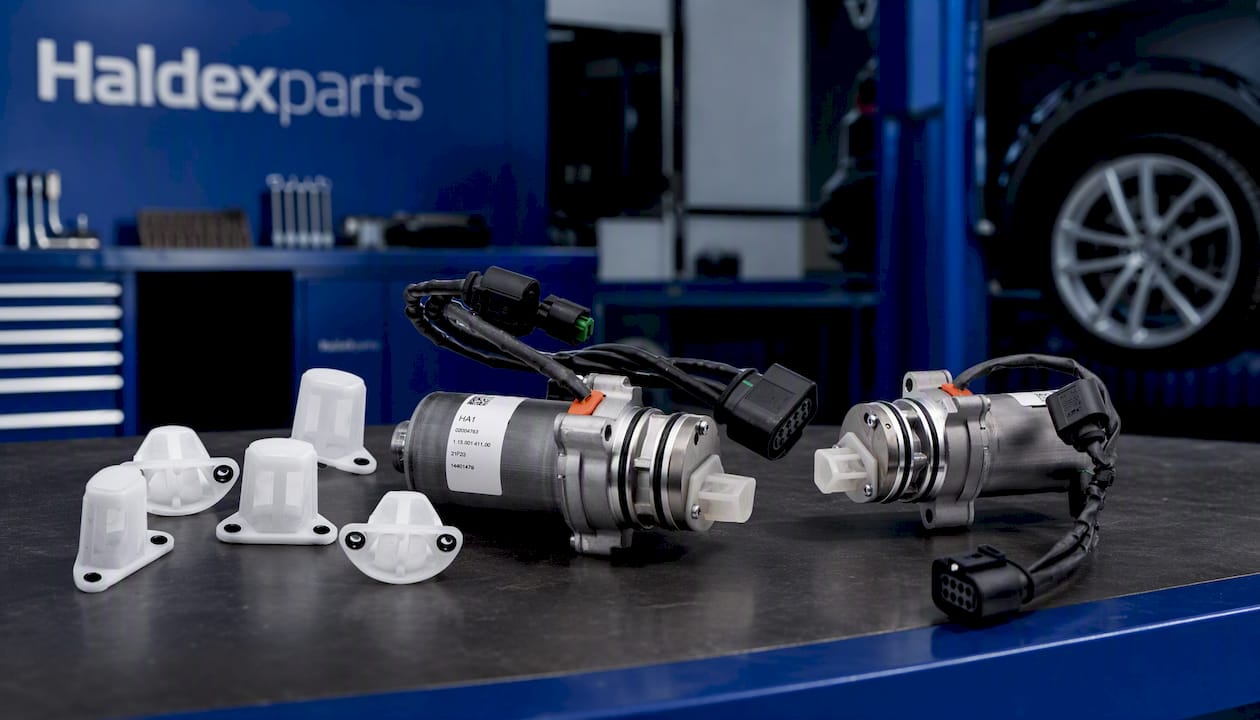
For first and second-generation systems, the AWD pump nose replacement tips cover the common failure point on older pump housings, useful if your bench test showed a mechanical fault rather than a full motor seizure. Fifth-generation owners running certain Porsche models can go straight to the Gen‑5 oil pump, part 9P1906271, while Audi R8 owners on the same generation need the 0D4906271A pump. If you’re replacing the pump outright, pairing it with fresh Haldex oil and a new gasket in one order avoids a second delay waiting on a seal you didn’t know you needed. Double-check your generation and OEM part number against your vehicle before ordering, since Gen‑5 fitments vary between manufacturers even on similar-looking housings. Where the fault traces back to the DEM rather than the pump, get it coded by a workshop with the right interface rather than attempting it solo. Browse the full range of Haldex pumps, oils and service kits on the Haldexparts site to find the exact match for your vehicle.
Sources
For deeper technical detail, Blown Fuse Diagnosis Basics covers the general electrical logic behind repeat fuse failures, while the fifth-generation Haldex breakdown explains the dual power-feed architecture in more detail. Always cross-check against your own vehicle’s wiring diagram or dealer resources where one is available, since fusebox layouts do vary between trims and model years.
- Blown Fuse Diagnosis Basics
- VW, Audi, Skoda, Seat: 5th-Generation Haldex – Details and Common Faults
- Car fuse keeps blowing: causes & how to fix
- All wheel drive not working Archive - Volvo XC Forums
FAQ
Why does my 4WD fuse keep blowing?
Repeated blows almost always mean an active short to ground or a Haldex pump drawing excessive current, rather than a run of bad fuses. Isolate the pump harness first to find out which side of the circuit is faulty.
Why does my fuse keep blowing immediately when I replace it?
An instant blow on reinstallation points to a hard short somewhere in the wiring or connector, since the circuit is failing before the pump even gets a chance to draw its normal current. A delayed blow after a few seconds usually points to the motor instead.
How do you test a Haldex pump?
Unplug the pump, apply a fused 12V supply to its terminals, and measure current draw with an ammeter while checking that it spins freely. High current, a stall, or no movement at all all indicate the pump has failed and needs replacing.
Why does my car fuse keep blowing every time I put a new one in?
This pattern means the short or overload is still present in the circuit, not that the fuses themselves are faulty. Fitting a higher-rated fuse to work around it removes the circuit’s protection and risks damaging the wiring loom.